ADHD Isn’t an Attention Deficit. It’s an Attention Regulation Difference. And the Name We Use Matters More Than We Think.


“ADHD isn’t an attention deficit.”
That sentence surprises people every time I say it in session. It surprises parents. It surprises the executives I coach. It even surprises clinicians who learned the diagnostic criteria one way and never questioned the label itself.
Here’s the problem. The name we gave this condition back in the 1980s was already inaccurate, and we’ve spent forty years living with the consequences.
The Name Was Never Quite Right
Attention Deficit Hyperactivity Disorder implies a shortage. Not enough attention. Not enough focus. Not enough effort, if you read between the lines the way most teachers, bosses, and family members do.
That’s not what’s actually happening in an ADHD brain.
The real issue isn’t a deficit of attention. It’s a difficulty regulating where attention goes, how much of it shows up, and how long it stays. Some days that looks like too little attention. Other days it looks like too much.
- Too many thoughts competing for space at once.
- Hyperfocus so intense that everything else disappears, including meals, meetings, and time itself.
- An inability to decide where to start, not because the task is too hard, but because every option feels equally loud.
- Constant switching between ideas, each one grabbing hold with the same urgency.
That’s not a deficit. That’s a regulation system that hasn’t learned how to filter and prioritize the way a neurotypical brain does. The volume knob works fine. It’s the dial that’s unpredictable.
Why the Wrong Name Causes Real Harm
Language shapes how people get treated, and this is where the naming problem stops being academic.
When someone hears “attention deficit,” they hear “not paying attention on purpose.” A manager hears an employee who doesn’t care about the project. A teacher hears a kid who isn’t trying. A partner hears someone who tunes them out during conversations that matter.
None of that is accurate, and all of it is common. I hear versions of this in nearly every intake I do with a newly diagnosed adult. They’ve spent years being told to focus harder, and no one told them their brain was already working incredibly hard, just not in the direction the task required.
The name sets up a conversation that starts from blame. “Why aren’t you concentrating?” instead of “What’s making it hard for your attention to land where you need it to?” One of those questions leads to shame. The other leads to a solution.
What a More Accurate Name Would Change
Some researchers and clinicians have proposed alternatives over the years. Attention Regulation Disorder. Variable Attention Stimulus Trait. None of these have replaced the clinical term, and I’m not holding my breath that the DSM will change it anytime soon. But the framing matters even without an official rename, because it changes what we do next.
If ADHD is a filtering and regulation difference, the right support isn’t “try harder” or “focus up.” It’s:
- Reducing cognitive load so the brain has fewer competing signals to sort through.
- Creating clear, external priorities instead of expecting internal ranking to happen automatically.
- Building environments that work with the brain’s natural rhythm of hyperfocus and drift, rather than fighting it.
- Recognizing that a capable, intelligent person can still struggle to start a task they genuinely want to do. That’s not a contradiction. That’s the disorder doing exactly what it does.
This is where I see the biggest shift happen with the clients (many high level professionals) I work with. Once they understand that ADHD is about regulation and not effort, they stop trying to white-knuckle their way through it and start building systems instead. That’s when performance actually improves. Not because they finally found enough willpower, but because they stopped fighting a system that was never designed to work that way in the first place.
Where AuDHD Fits Into This
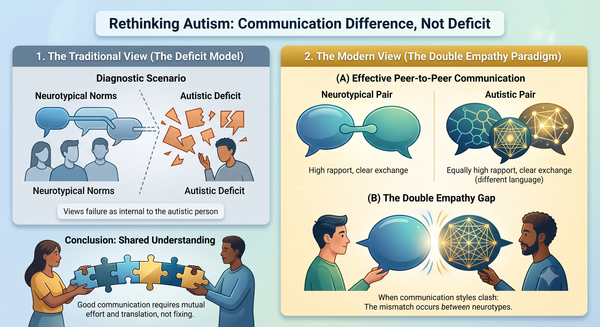
This gets even more layered for people who are AuDHD, meaning Autism and ADHD together. It’s an incredibly common combination, and it complicates the “attention deficit” myth even further.
Autism often comes with a different relationship to attention entirely. Many Autistic people experience something closer to monotropism, where attention naturally pulls deep into one interest or task at a time, rather than spreading across several. That’s not a flaw either. It’s a different, often highly effective way of processing the world.
Now put that alongside ADHD’s shifting, unpredictable attention regulation, and you get two systems that don’t always agree with each other. One part of the brain wants to lock in and go deep. Another part wants to scan, switch, and chase the next spark. The result can look like intense hyperfocus one day and complete task paralysis the next, sometimes on the exact same project.
For AuDHD adults, this shows up in ways that get misread constantly:
- Deep expertise in a narrow area, alongside real difficulty starting or switching tasks outside of it.
- Sensory input competing for the same limited bandwidth as attention itself, so a loud room or a scratchy shirt can derail focus just as much as a distracting thought can.
- Masking both traits at once, which takes an enormous amount of energy and often gets mistaken for someone who is simply “fine” or “high functioning,” when they’re actually running on empty by early afternoon.
- Needing structure and routine to manage the Autism side, while also needing flexibility and novelty to manage the ADHD side. Those two needs pull in opposite directions, and building a life that honors both takes real intention.
The attention deficit framing fails AuDHD folks twice over. It misses the regulation piece for ADHD, and it completely ignores that attention was never the core issue on the Autism side to begin with. What AuDHD adults usually need isn’t more focus. It’s less competing demand on a nervous system that’s already working overtime to process two different operating systems at once.
Changing the Question Changes the Outcome
The old question was “why can’t you concentrate.”
The better question is “what would make it easier for your attention to land where you need it.”
That single shift changes how a workplace accommodates someone. It changes how a parent talks to their kid after a rough homework session. It changes how someone with ADHD talks to themselves at eleven at night, replaying everything they didn’t get done that day.
The name gave us decades of misunderstanding. The reframe gives us a path back to accuracy, and honestly, to a little more kindness.
What’s one thing you wish
more people understood about ADHD?