Autism Was Never One Thing. The Science, and the Diagnosis Itself, Prove It.

You’ve probably seen a headline claiming scientists found a drug that “treats autism.” It happens every few years, with a different molecule each time. Oxytocin. Psychedelics. The gut microbiome. Most recently, a drug called rapamycin.
I’m not going to spend much time on the drug itself, because the drug isn’t really the story. The story is something bigger, and it’s been true for as long as autism has existed as a diagnosis: autism was never one thing. Not biologically. Not even on paper.
Why moving away from a singular cause is the most important shift in autism research.
For a long time, autism research was stuck on one question: what causes autism? That framing assumed there was a single answer waiting to be found. One gene, one brain difference, one trigger.
That’s not what good researchers ask anymore. The better question, the one driving real progress, is this: what are the many different biological pathways that can lead to autistic traits, and how do those pathways show up differently in different people?
That shift sounds subtle. It isn’t. It’s the difference between searching for one lock and one key, and understanding you’re actually looking at hundreds of different locks.
Autism isn’t one thing biologically
Autism describes a wide range of experiences: differences in communication, sensory processing, attention, learning, regulation, and how the brain organizes information. But two autistic people can have completely different genetic profiles, nervous systems, and support needs, even while sharing the same diagnosis.
That’s why researchers now describe autism as highly heterogeneous. There isn’t one autism gene. There isn’t one autism brain pattern. And there isn’t one autism treatment, no matter how badly a headline wants there to be one.
Some of what we know so far:
- Autism can involve rare genetic changes that carry a strong likelihood of autism, alongside many common variations that each contribute only a small effect.
- Some genetic conditions are linked to autism at higher rates, including Fragile X syndrome and tuberous sclerosis complex, but most autistic people don’t have an identified single-gene cause at all.
- Brain differences show up in how neurons communicate, how brain networks connect, how sensory information gets filtered, and how attention and motivation systems run, and they don’t look the same from person to person.
The history of autism diagnoses shows just how much our understanding has grown, proving that it’s never been just one thing.
Here’s the part people rarely think about. If autism biology has always been this varied, it makes sense that the diagnosis built to describe it has kept changing too.
Autism didn’t exist as its own diagnosis until 1980. Before that, the first two editions of the DSM grouped it in with schizophrenia. The DSM-III finally separated the two and described autism as a distinct “pervasive developmental disorder,” with symptoms that had to appear before 30 months of age. That was progress, but it was also narrow. It described one fairly specific presentation, and it left a lot of people out.
By 1994, the DSM-IV expanded the picture. It introduced separate diagnoses under the pervasive developmental disorder umbrella: autistic disorder, Asperger’s disorder, PDD-NOS, Rett syndrome, and childhood disintegrative disorder. For the first time, the manual acknowledged that autism didn’t look one way. It looked like several related but distinct things.
Then in 2013, the DSM-5 changed course again, and this is the part worth sitting with, because it shows exactly how much the old categories didn’t hold up:
- Autistic disorder, Asperger’s disorder, and PDD-NOS were folded together into one diagnosis: Autism Spectrum Disorder. The distinctions clinicians once treated as separate conditions turned out to describe points on the same spectrum, not different disorders.
- Childhood disintegrative disorder was removed from the autism category entirely. Its pattern of severe developmental regression didn’t match the same model as the rest of the spectrum.
- Rett syndrome was pulled out too, for a very specific reason. By the time DSM-5 was written, researchers had identified its cause: a mutation in the MECP2 gene. Once a condition has a known, distinct genetic cause, it stops being classified by behavior alone, which is how autism itself is still defined, since no single genetic or biological marker accounts for it.
The old three-part model of impairment, social interaction, communication, and repetitive behavior, also became two: social communication, and restricted or repetitive patterns. The DSM-5 added severity levels and, importantly, allowed clinicians to consider a person’s developmental history and not just how they present right now. That change opened the door for more people to be recognized later in life, including many who had spent years masking or being misdiagnosed with something else.
Each of these revisions wasn’t the manual finally getting it right. It was the field catching up, a little more each time, to something autistic people and their families already knew: this isn’t one condition with one face. It’s a spectrum in the truest sense, and even our diagnostic language has had to keep evolving to hold it.
That history also explains something a lot of late-identified adults feel in their bones. If you were a kid in the 90s or early 2000s and didn’t fit the narrow DSM-III or DSM-IV picture, you may have been missed entirely. The criteria changed. You didn’t.
How Rapamycin Fits Into the Broader Context of Autism Research
This is where the drug comes back in, briefly, as one small example of a much bigger pattern. mTOR is a biological pathway involved in cell growth and brain development. In a few rare genetic conditions linked to autism, like tuberous sclerosis complex, that pathway can become overactive. Rapamycin regulates mTOR, which is why some researchers are studying whether it might help people in that specific subgroup.
That’s a legitimate, narrow question. It is not the same as “rapamycin treats autism.” Giving the same medication to every autistic person would be like giving everyone with a headache the same pill without knowing if the cause is dehydration, migraine, or infection. It might help a few. It would miss almost everyone else, because it was never aimed at their actual biology.
What’s actually exciting here
The real excitement isn’t a single molecule. It’s a shift in how medicine is starting to think about autism altogether. Instead of chasing one treatment for everyone, researchers are working toward identifying biological subtypes and matching support to the people most likely to benefit from it. That’s precision medicine, and it’s a far better fit for something this varied.
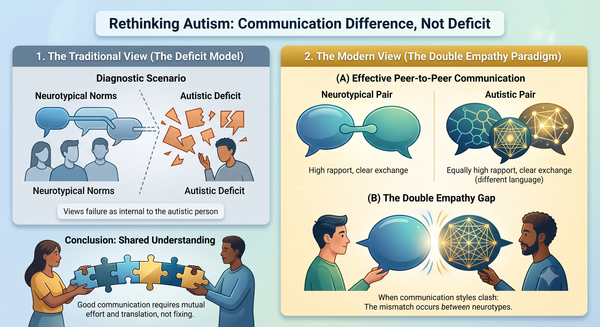
Adopting a neuroaffirming perspective means recognizing that autism is not a condition to be cured or erased, but a diverse manifestation of human neurology. By shifting away from a medical-deficit model, we can focus on providing individualized support for specific challenges—such as sensory processing or executive functioning—while respecting the unique ways autistic individuals exist in the world.
derstanding autism biology does not necessitate an attempt to “fix” it. Many autistic traits represent a natural variation in human neurology rather than a malfunction. However, it is equally important to acknowledge that many autistic people face genuine challenges—including sensory overload, executive dysfunction, anxiety, sleep disturbances, and the exhaustion of navigating a world built for a different kind of nervous system—that deserve compassionate, tailored support.
The ultimate goal is not to make autistic people “less autistic.” Instead, it is to understand the underlying biology to reduce suffering where it exists and offer individualized care that empowers people to thrive on their own terms.
Where this is actually headed
The future of autism research and autism care probably isn’t one medication, and it was never going to be one diagnostic box either. It’s a more personalized picture: your genetics, plus your biology, plus your environment, plus your lived experience, equals your own individual support plan.
Autism was never one thing to solve. It never fit neatly into 1980’s criteria, or 1994’s, or even 2013’s. It’s a complex, varied form of human neurobiology, and both the science and the diagnosis are still catching up to how varied it really is.
If this deep dive into autism research helped you understand yourself or someone you love, make sure to subscribe for more updates.
Just a reminder: there’s nothing wrong with your wiring.