Autistic People Have a Built-In Lie Detector (And It’s Backed by Science)

Share
Autistic People Have a Built-In Lie Detector (And It’s Backed by Science)

You know that feeling when something’s off — before a single word has been said, before anyone else has noticed, before you can even explain it to yourself?

That’s not you being dramatic. That’s not anxiety inventing problems. That’s your nervous system picking up information that most people simply don’t have access to. And there’s actual science behind it.

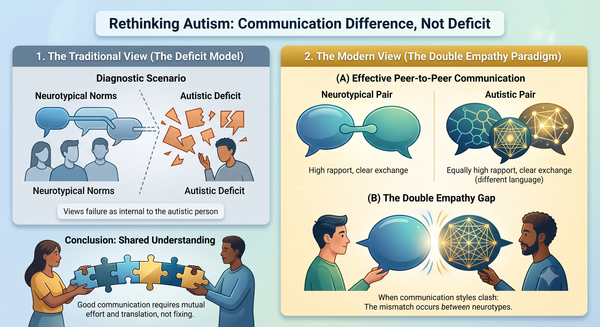
Here’s the thing: autistic people have spent decades being handed a story about themselves that was never really accurate. The “struggles to read social situations” narrative? It was built on a pretty narrow definition of what social awareness even looks like — and it missed something huge. Because while some social scripts might feel awkward or exhausting, the ability to sense what’s real underneath those scripts? That’s where autistic perception genuinely shines.

The research backs this up. So does the biology. So does basically every autistic person who’s ever said I knew something was wrong and then watched everyone else slowly catch up.

This piece is for autistic people who’ve spent years second-guessing a sense that was right all along — and for the employers and colleagues who want to finally understand what they’re actually working with. (It’s not a communication quirk. It’s a finely tuned human detection system, and most workplaces are sitting on it without realising.)

Autistic people don’t wait for words. By the time a sentence ends, the room has already been read.

Let’s get into it.

The Processing Order Is Different — and That Matters

In typical neurological processing, communication usually flows like this: words → tone → emotion → conclusion.

For many autistic people, that order is reversed: emotion → tone → truth → energy pattern → words.

Research into autistic sensory and cognitive processing consistently shows that autistic people prioritize non-verbal and emotional data first. The verbal content arrives last — and by then, the body has already reached its own conclusions.

This is why autistic people sometimes interrupt, seem distracted, or appear to “already know” where a conversation is going. They do. Words are genuinely the slowest part of human communication, and many autistic people are working several steps ahead of them.

For employers: When an autistic team member says “something feels off” without being able to explain why yet, that’s not vagueness. That’s real-time sensory and emotional processing happening at a depth most people don’t have access to.

woman using laptop and looking side
Photo by Icons8 Team on Unsplash

Pattern Recognition Over Narrative

Autistic perception tends to be pattern-based rather than narrative-based. Where neurotypical processing often follows the story being told, autistic cognition is tracking the structure underneath it — the rhythm of speech, the gap between what’s said and what’s felt, the micro-expressions that flash before someone composes their face into something more socially acceptable.

This is part of why autistic people can find social environments so exhausting. It’s not that they’re failing to read the room. They’re reading everything in it, all at once, with very few filters.

a neon sign that says houston we have a rocket on it
Photo by Yongsu Go on Unsplash

The research on interoception — the body’s internal sense of its own state — shows that many autistic people have heightened interoceptive awareness. The gut-brain axis, already well-documented in neuroscience, appears to function with particular intensity in autistic biology. Before conscious evaluation kicks in, the body is already responding. “I don’t know why, I just know” is not irrational. It is the body translating truth before language catches up.


The Amygdala Isn’t Broken — It’s Calibrated Differently

There’s a long-standing (and frankly tired) narrative that autistic amygdala function represents a deficit. What the research actually shows is that the autistic amygdala is exquisitely sensitive to social and emotional threat rather than primarily physical danger.
Where a neurotypical nervous system might ask is this physically safe? — an autistic nervous system is asking is this emotionally honest? Is the energy here consistent? Is something being hidden?

That’s not dysfunction. That’s a different kind of threat-detection — one that’s particularly useful in human environments full of social complexity, hidden power dynamics, and institutional dishonesty.

a group of tin cans sitting on top of a blue and pink floor
Photo by Growtika on Unsplash

The Heart-Brain Connection

The HeartMath Institute (near San Jose, CA) has current research that has shown that the heart communicates with the brain electromagnetically and that heart-brain coherence affects emotional perception and decision-making. For autistic people, the connection between felt emotion and conscious thought tends to be less suppressible than in neurotypical wiring. There’s less capacity to “decide not to feel” something.

This means autistic people often can’t fake their feelings — and often struggle to be around others who are faking theirs. Inconsistency between what someone says and what they feel registers as active dissonance. It’s physically uncomfortable. This isn’t sensitivity as weakness. It’s the body refusing to accept false data.

For autistic people reading this: that thing where you feel physically unwell around dishonesty, or where something “just feels wrong” before you can explain it — your nervous system is working. It’s giving you real information. Learning to trust that, and to find environments where that signal is valued rather than dismissed, is genuinely life changing.


When Autistic “Overreaction” Is Actually the Correct Reaction

One of the most damaging things that happens to autistic people is having their responses labelled as disproportionate. When an autistic person reacts strongly to something others haven’t noticed yet, it can look like overreaction. Sometimes it is. And sometimes — more often than is acknowledged — the autistic person detected something real that the room hadn’t caught up to yet.

The pattern, across autistic life experience, is consistent: they knew. They said something. They were dismissed. And then, later, everyone else found out.

For employers: creating space for autistic team members to flag discomfort, misalignment, or “something feels wrong” — even when they can’t fully articulate it yet — is not accommodation as charity. It is genuinely useful organizational intelligence. Autistic pattern-detection and truth-sensitivity are professional assets that most workplaces are actively suppressing through environments that pathologize directness and penalize emotional honesty.


The Paradox No One Talks About

Here is the uncomfortable irony at the heart of autism research and public discourse: autistic people are consistently described as lacking social awareness, while simultaneously demonstrating a capacity to read emotional undercurrents, detect deception, and understand human motivation at a level that often exceeds what the person being observed understands about themselves.

These things cannot both be true. What is actually true is that autistic people often struggle with the performance of social norms — the scripts, the small talk, the strategic self-presentation — while having exceptional access to the reality underneath those performances.

That is not a social deficit. That is a different relationship with social truth.

This is the sign you've been looking for neon signage
Photo by Austin Chan on Unsplash

What This Means in Practice

For autistic people:

Your truth-detection is real. The nausea around manipulation, the instant recognition of safe people, the way you knew something was wrong before anyone else admitted it — that’s your nervous system giving you accurate information. The work isn’t learning to doubt it. The work is finding environments that don’t require you to override it constantly.

For employers and colleagues:

Autistic directness, pattern-flagging, and discomfort in environments of inconsistency aren’t problems to manage. They’re signals worth paying attention to. An autistic team member who says “I don’t trust this process” or “that meeting felt wrong” is not being difficult. They may be the most reliable quality-check in the room.


Autism is not a social deficit dressed up in deficit language.

It is, in a very real neurological sense, truth as a nervous system — operating at a frequency most people have been socially trained to ignore.