Rumination Isn’t a Character Flaw. It’s a Brain Pattern.
You're not overthinking because something is wrong with you. You're overthinking because your brain got very good at it.

If you’ve ever caught yourself replaying a conversation, a mistake, or a worst-case scenario on a loop — you’re not broken. You’re not weak. Your brain is doing exactly what it was trained to do.
That’s the part worth sitting with.

Rumination isn’t just a bad habit. It’s a neurological pattern. And neuroscience research confirms what many people already feel in their bodies: chronic negative thinking doesn’t just drain you emotionally. It changes your brain — physically.
What’s Actually Happening in Your Brain
When you repeatedly focus on negative experiences, your brain activates its stress circuitry and releases cortisol. One episode of stress isn’t the problem. The problem is chronic elevation — what happens when the stress response stays switched on because your thoughts keep retriggering it.
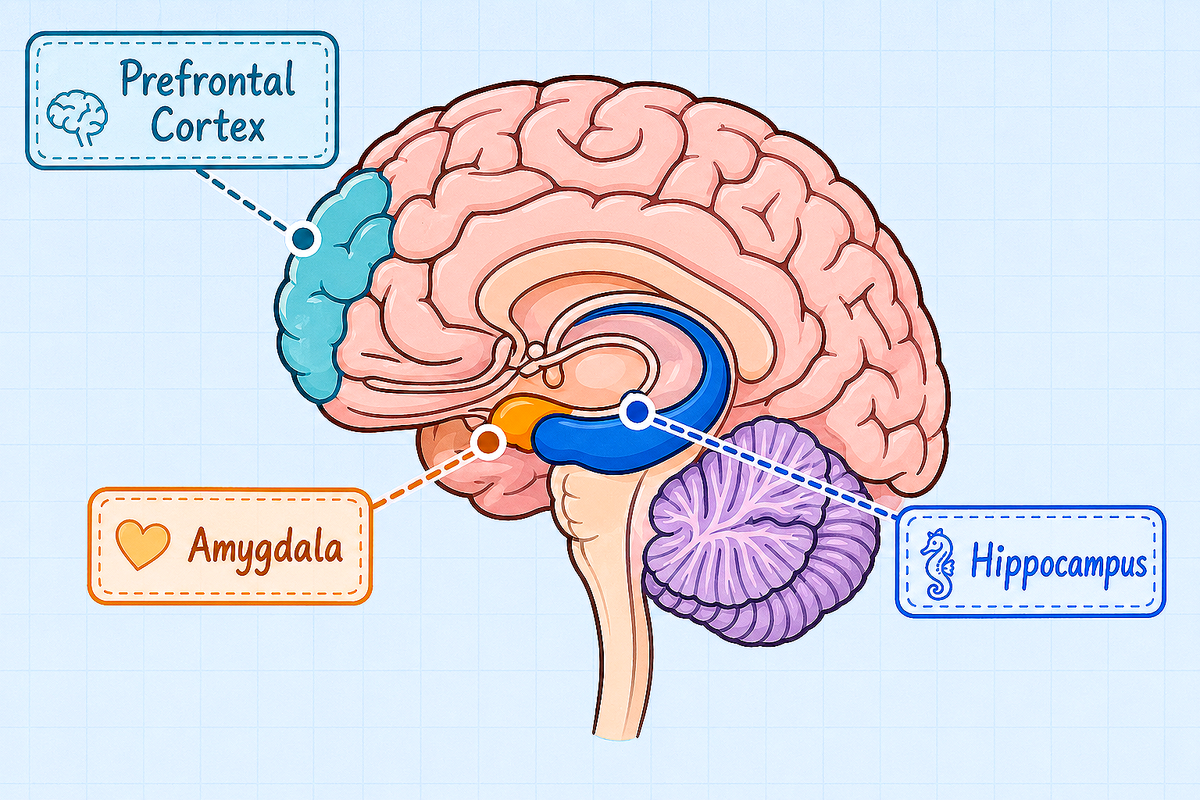
Prolonged cortisol elevation affects two regions most directly:
The hippocampus — responsible for memory formation and learning. Chronic stress can actually reduce its volume over time. This is why rumination often makes it harder to retain new information or see situations clearly.

The prefrontal cortex — the part of your brain that handles decision-making, judgment, and emotional regulation. Under chronic cortisol exposure, this region becomes less active and less effective. That’s why it gets harder to problem-solve or self-regulate when you’re stuck in a rumination cycle. It’s not a personal failure. The hardware is being compromised.
Research published in Biological Psychiatry and supported by ongoing work from stress neuroscientists like Bruce McEwen at Rockefeller University has documented these structural changes in people with chronic stress and depressive rumination. The hippocampus, in particular, shows measurable volume reduction in people who ruminate chronically — and some of that volume can be restored with intervention.
Why It Gets Harder to Stop
Here’s what makes rumination especially frustrating: the more you do it, the more natural it feels.
Every time a thought pattern activates, it strengthens the neural pathway associated with it. This is the principle behind Hebb’s Law — neurons that fire together, wire together. Repeated negative thinking doesn’t just reflect a stressed brain. It builds one. It makes the brain more efficient at detecting threats, more likely to interpret ambiguity as danger, and faster to default to anxious or defensive responses.
This is not a moral failure. It’s neuroplasticity working against you — because it was shaped by experience, environment, and sometimes survival.
Many people who struggle with rumination grew up in environments where hypervigilance was adaptive. Scanning for problems, anticipating criticism, preparing for the worst — these were protective strategies. The brain learned them because they worked at some point. The challenge is that the same circuitry keeps running even when the original threat is long gone.
What Actually Helps
The research on interrupting rumination is consistent, and the interventions don’t require you to “think positive” or pretend the hard things aren’t real. What they require is redirection — consistently, over time — so the brain begins to build new pathways alongside the old ones.

Here are several approaches with solid evidence behind them:
1. Cognitive Defusion (from ACT) Rather than trying to stop a thought, you learn to observe it without merging with it. Instead of “I always mess things up,” the practice shifts to noticing: “There’s that thought again.” You’re not arguing with the thought. You’re just stepping back from it. This weakens the emotional charge without suppression — which research shows tends to backfire anyway.
2. Behavioral Activation Rumination thrives in stillness. One of the most well-supported interruptions is physical movement or intentional engagement in a low-demand activity — a walk, a simple task, anything that pulls your attention into the present moment through your body. This isn’t avoidance. It’s interrupting the loop long enough for the nervous system to downregulate.
3. Constructive Worry Time For people who ruminate because their brain genuinely needs to process, scheduled “worry time” can help. Set a 15-minute window. Write down the concern. Then close it. The brain gets the signal that the thought was received — which reduces the urgency to keep cycling through it. This is particularly effective for ADHD and anxious presentations where unresolved loops stay active in working memory.
4. Solution-Focused Reframing This isn’t toxic positivity. It’s a neurological redirect. When you shift from “why did this happen” to “what can I do about this,” you move activation from the threat-detection system toward the prefrontal cortex — the part of the brain that actually solves problems. Even when there’s no clear solution, asking a forward-facing question changes the direction of neural activation.
5. Mindfulness-Based Stress Reduction (MBSR) MBSR has decades of research behind it, including neuroimaging studies showing structural brain changes after 8 weeks of practice. Sara Lazar’s work at Harvard found measurable increases in cortical thickness in areas related to attention and interoception among MBSR participants. The practice doesn’t ask you to empty your mind. It trains you to notice when your mind has wandered — and bring it back. That act of noticing and returning is the skill.
The Direction You Train Your Brain Matters
None of this means rumination is your fault. And none of it means you simply choose your way out of it. But it does mean the brain is not fixed. Neuroplasticity works in both directions — it’s the same mechanism that deepened the rumination pattern, and it’s the mechanism that can gradually shift it.
Redirecting attention — toward solutions, toward the present moment, toward what’s actually here rather than what might go wrong — lowers cortisol signaling over time and supports healthier neural remodeling. Not because of willpower. Because of biology.
What you consistently think about trains your brain.
That’s not a judgment. It’s an opening.

Sources and Supporting Research
- McEwen, B.S. (2007). Physiology and neurobiology of stress and adaptation. Physiological Reviews.
- Lazar, S.W. et al. (2005). Meditation experience is associated with increased cortical thickness. NeuroReport.
- Gotlib, I.H. & Joormann, J. (2010). Cognition and depression. Annual Review of Clinical Psychology.
- Hebb, D.O. (1949). The Organization of Behavior. (foundational neuroplasticity framework)
- Nolen-Hoeksema, S. (2000). The role of rumination in depressive disorders. Journal of Abnormal Psychology.
- Hayes, S.C. et al. (2006). Acceptance and Commitment Therapy. Behaviour Research and Therapy.