The Body Budget: The Invisible Energy Behind Every Visible Crisis
It's not your fault - it's your nervous system doing what it does.

Most people assume that meltdowns, shutdowns, or emotional crashes come out of nowhere. They don’t. They’re the end of a process that started long before anyone noticed.
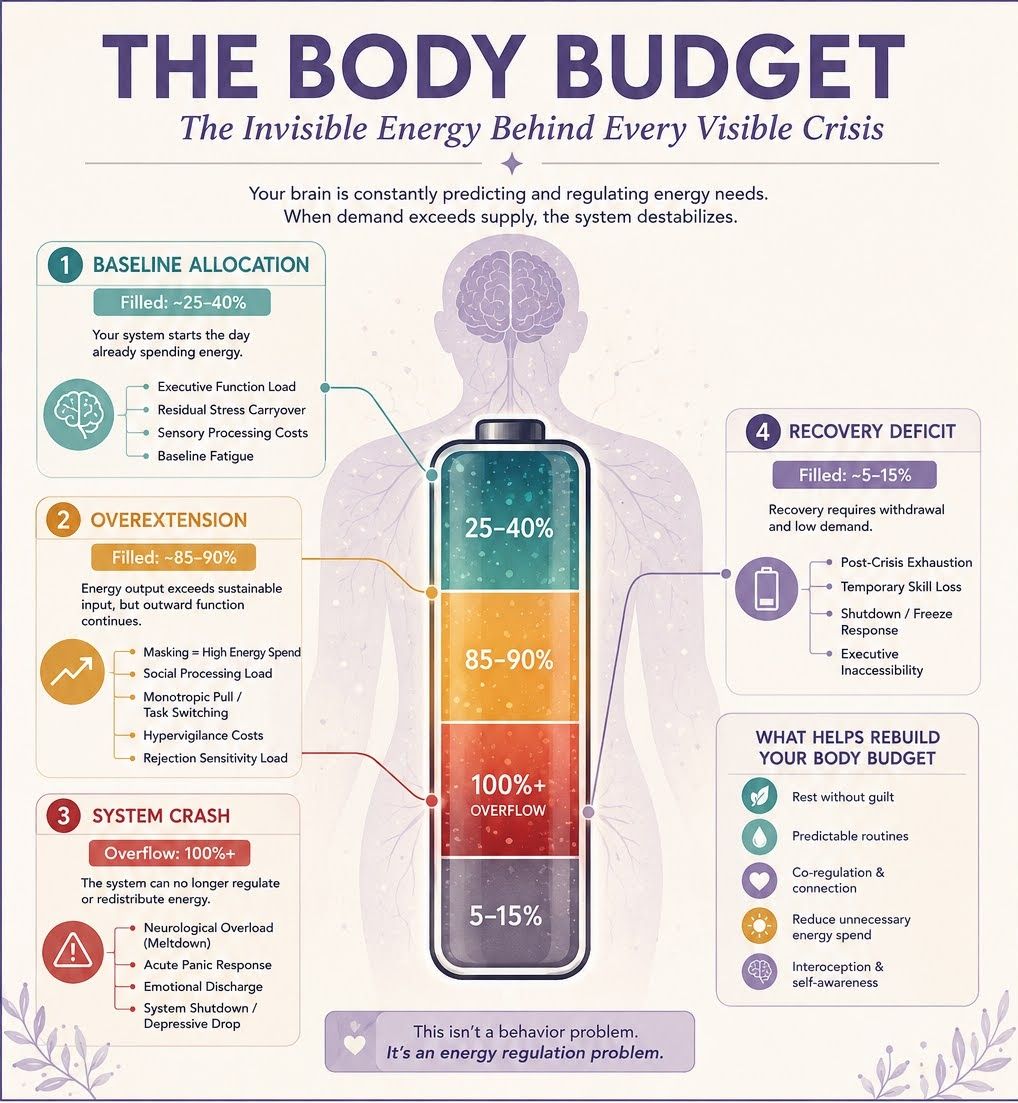
This image maps that process.

The concept comes from neuroscientist Lisa Feldman Barrett’s work on how emotions are actually made. Your brain isn’t reacting to the world — it’s constantly predicting what your body will need and managing your energy accordingly. She calls this allostasis. I call it your body budget. Same thing: your nervous system running the numbers all day, every day, trying to keep you functional.
The problem is that most neurodivergent people start the day already in deficit.
Stage 1 — Baseline Allocation (25–40% filled) Before you’ve done a single thing, your budget is already being drawn on. Executive function load, residual stress from yesterday, the cost of processing a sensory environment that was never designed for your nervous system — it’s all spending. You haven’t even gotten out of bed yet.
Stage 2 — Overextension (85–90% filled) This is the zone most high-functioning neurodivergent people live in. You’re still showing up. Still performing. Still managing. But the costs are stacking: masking takes enormous energy, social processing is expensive, task-switching fights against a monotropic brain, and hypervigilance runs quietly in the background whether you notice it or not. From the outside, everything looks fine. Inside, the tank is almost gone.
Stage 3 — System Crash (100%+ overflow) When demand finally exceeds supply, the system doesn’t politely ask for a break. It crashes. Neurological overload. Meltdown. Acute panic. Shutdown. Depressive drop. These aren’t behavioral failures or emotional immaturity. They’re what happens when a system that has been running on fumes finally hits the wall.
Stage 4 — Recovery Deficit (5–15% filled) After a crash, the system doesn’t bounce back quickly. It goes into conservation mode — temporary skill loss, executive inaccessibility, shutdown or freeze. This is the part that gets misread as laziness or avoidance. It’s actually repair.

The bottom of this image says it plainly: This isn’t a behavior problem. It’s an energy regulation problem.
That reframe matters. Because when we stop asking “why can’t they just hold it together” and start asking “what is this nervous system actually carrying” — the whole picture changes. So does the support.