The Communication Illusion: Why We Need to Rethink Autism and "Social Deficits"
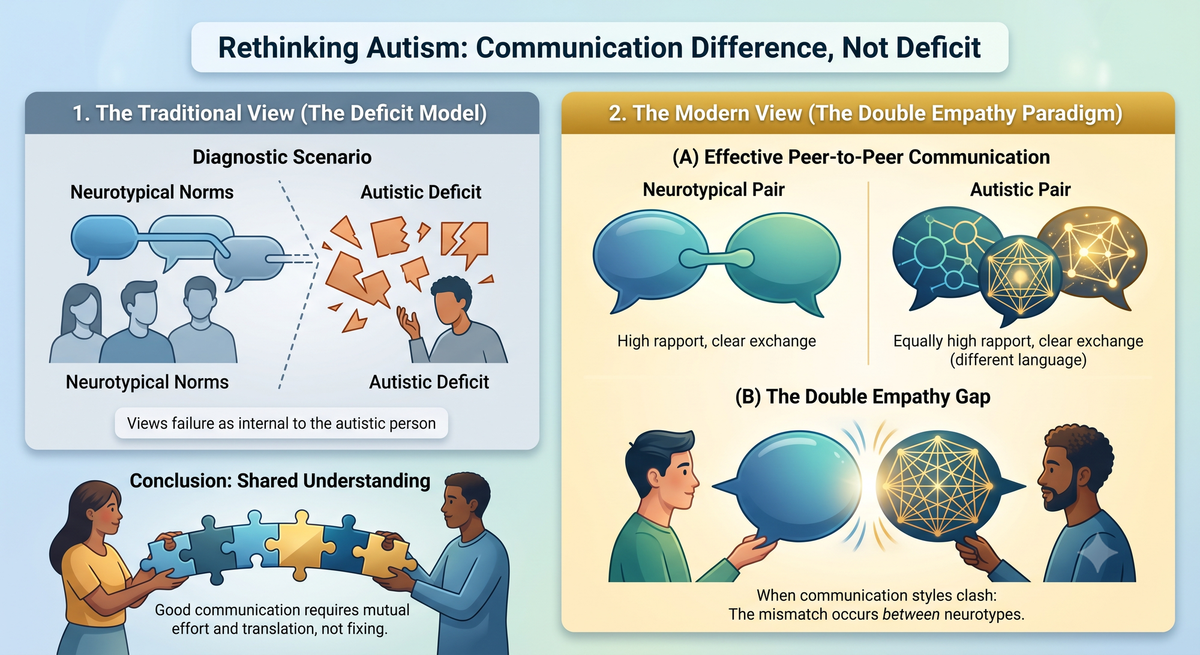
If you open the DSM-5, the diagnostic manual used by mental health professionals worldwide, you will find autism described largely through a lens of lack. Specifically, it highlights "deficits in social communication."
For decades, the medical community has used the non-autistic (neurotypical) majority as the undisputed baseline for "good" communication. From this perspective, the way autistic people communicate has been inherently pathologized as 'wrong' or 'broken.'
But what if the problem isn’t a deficit within the autistic brain? What if, instead, we are simply witnessing a profound clash in communication cultures?
Recent research is turning the traditional medical model on its head, revealing that at least some of what we’ve historically labeled a "communication deficit" is far better understood as a communication difference.
The "Double Empathy" Problem
In 2012, autistic researcher Dr. Damian Milton introduced a concept that has revolutionized modern autism research: The Double Empathy Problem.
Historically, experts claimed autistic individuals lacked "theory of mind"—the ability to understand and empathize with the thoughts and feelings of others. Milton pointed out a glaring blind spot in this theory: empathy and communication are two-way streets.
When people with fundamentally different ways of experiencing the world interact, both parties will struggle to understand each other.
- Non-autistic people struggle just as much to read the facial expressions, tone, and intentions of autistic people.
- The communication breakdown is mutual, relational, and dynamic—not a solitary flaw residing within the autistic person.
What the Data Actually Says
If autistic people truly had an inherent deficit in communication, their interactions should break down regardless of who they are speaking with. But that is not what the data shows.
In landmark studies testing information transfer and rapport, researchers grouped participants into three categories: all-autistic, all-non-autistic, and mixed groups. The results were striking:
- Peer-to-Peer Success: The all-autistic groups shared information just as effectively, accurately, and swiftly as the all-non-autistic groups.
- The Breakdown: The significant drops in communication accuracy only occurred in the mixed groups.
- High Rapport: Autistic individuals consistently reported feeling higher levels of rapport, comfort, and mutual understanding when communicating with other autistic individuals.
Autistic people communicate perfectly well with one another. The friction occurs when two different neurotypes attempt to bridge the gap.
The Cross-Cultural Analogy
A helpful way to conceptualize this shift is through the lens of culture. Imagine a person from Japan and a person from the United States trying to negotiate a business deal without understanding each other's social cues, idioms, or body language.
When they inevitably misunderstand one another, we do not diagnose either person with a "social communication deficit." We recognize that two distinct cultures are clashing.
Autistic communication is its own distinct culture. It frequently favors:
- Directness and literal language over subtle hints.
- "Infodumping" (sharing deep knowledge about intense interests) as a method of connection and love language.
- Parallel play (enjoying shared space and activities without the pressure of constant eye contact or forced small talk).
These are not broken versions of neurotypical communication; they are simply different operating systems.
Moving Forward: From Fixing to Bridging
For adult professionals, educators, and clinicians, this paradigm shift is deeply consequential. It demands that we stop trying to "fix" autistic communication or force autistic individuals to mask their natural traits just to make the neurotypical majority more comfortable. Masking is exhausting and often leads to severe burnout.
Instead, the responsibility of communication must be shared. By recognizing the Double Empathy Problem, we can begin building bridges of mutual translation, fostering environments where all neurotypes can genuinely flourish and thrive.