The Hidden Tax of an Ordinary Day


A client told me that they’d had a “good day.” No meltdowns, no shutdowns, nothing dramatic. Then they described that day to me. They’d worn their Loop adaptable earplugs on the drive to work because the radio ads felt like static in their skull. They’d rehearsed a two-sentence greeting for the front desk three times before walking in. They’d eaten lunch alone in their car because the break room lighting made their eyes ache and the conversation required more small talk than they had left in them.
By their own definition, that was a good day.
This is the part people miss. When we talk about autism and frustration, we tend to picture the visible moments. The meltdown in the grocery store. The shutdown after a long shift. What we don’t picture is the hours of friction that happen before any of that, the ordinary grind of getting through a day that was never built with an autistic nervous system in mind.
Frustration isn’t the exception. It’s the baseline.
Most autistic adults I work with aren’t frustrated because something went wrong. They’re frustrated because everything is slightly, constantly effortful, and nobody around them can see it.
Think about what a non-autistic day requires versus what an autistic day requires. A neurotypical brain filters out the hum of fluorescent lights, reads a coworker’s tone without translating it, switches from one task to another without losing its place, and tolerates a last-minute schedule change without much cost. None of that is automatic for a lot of autistic people. Each one is a small, separate job, running in the background, all day long.
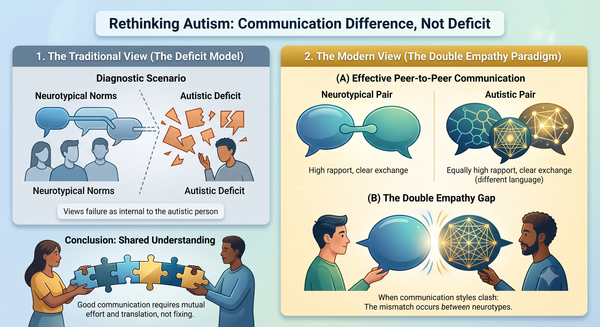
That’s not a metaphor. It’s closer to running two operating systems at once. One is doing the actual task in front of you. The other is doing constant translation work: reading faces, managing sensory input, predicting what’s expected, calculating whether it’s safe to say what you actually think. I call this translation fatigue, and it’s one of the most under-recognized forms of exhaustion I see in my practice.
Why it doesn’t look like frustration from the outside
Here’s where it gets complicated. A lot of autistic adults have spent years learning to hide the cost of all that translation. Not because they’re being dishonest, but because showing it has usually gone badly for them. So the frustration gets folded inward. It shows up as a headache nobody can explain, a short temper by 4pm, a sudden need to cancel plans that looked fine on the calendar.
From the outside, it can look like someone is being difficult, or sensitive, or “making a big deal out of nothing.” From the inside, it’s the accumulated weight of a hundred small demands that most people never have to notice, let alone manage.
This is where a lot of my clients start to second-guess themselves. If nobody else seems bothered by the meeting running long, or the fluorescent lights, or the sudden change in plans, the conclusion they reach isn’t “this environment is a poor fit for my nervous system.” It’s “something is wrong with me for finding this hard.” That conclusion is wrong, but it’s an understandable one, given how invisible the actual cost has been kept.
What this looks like in a boardroom, not just a break room
This isn’t only a personal or clinical issue. It shows up in performance reviews, in team dynamics, in who gets labeled “difficult” versus “high potential.” An autistic employee who needs written follow-up after verbal meetings isn’t being rigid. They’re managing a real difference in how instructions land and stick. Someone who seems short-tempered by the end of a client-facing day may be running on a sensory and social deficit that built up hour by hour, invisible to everyone but them.
Organizations that understand this stop treating it as a personality problem and start treating it as a design problem. The same way you wouldn’t blame someone for struggling to read in dim light, you don’t blame someone for struggling to function in an environment that taxes their processing all day without any recovery built in.
This is a pattern I see often enough that it stopped surprising me. A client gets let go from a job they were good at. On paper, the reason is usually something like “poor cultural fit” or a string of write-ups for tone. What’s actually happening underneath is quieter than that. They start asking for meeting agendas in advance because verbal-only instructions don’t stick, and that gets read as inflexible. They stop forcing eye contact during hard conversations because it’s pulling processing power away from the words, and that gets read as disengaged. By the time they’re let go, a manager has usually built an entire narrative about their attitude, and not one piece of it is actually about their attitude. It’s about a nervous system that had been quietly asking for a small accommodation and getting graded down for it instead.
That’s the part that’s hard to sit with. These clients weren’t fired for underperforming. They were fired for a mismatch nobody bothered to name, then handed the story that the mismatch was a character flaw. That’s what being chronically misread does. It doesn’t just cost you the job. It costs you the accurate account of what happened. You’re left holding someone else’s misreading of you and asked to treat it as fact, on top of the exhaustion that got you there in the first place.
This is why misreading is its own injury, separate from whatever incident triggered it. Getting misunderstood once is just a misunderstanding. Getting misunderstood in the same way, over and over, by people with power over your job or your relationships, starts to erode your ability to trust your own read of a situation. A lot of my clients don’t come in asking for help managing frustration. They come in asking whether they can trust their own perception at all, because so many authority figures have told them, directly or indirectly, that their experience of a situation was wrong.
What actually helps
The goal isn’t to eliminate frustration. Some of it is just the reality of being a particular kind of brain in a world built around a different one. The goal is to stop treating that frustration as a personal failing and start treating it as information.
A few things I tell clients, and myself:
The exhaustion at the end of an “easy” day is real, even if you can’t point to a single hard thing that happened. Translation work has a cost, even when it’s invisible.
Recovery time isn’t optional. If your day requires constant filtering and predicting, you need real recovery on the other side of it, not just less to do, but less input altogether.
Naming the pattern changes your relationship to it. Once my client understood that their exhaustion had a name and a reason, they stopped treating it as evidence that something was wrong with them. They started treating it as data about what kind of day they’d actually had.
Your wiring was never the problem. The mismatch between that wiring and an environment built for a different kind of brain, that’s the problem. And mismatches can be redesigned. People can’t.