They Said “Did Your Best.” You Heard Something Else. Both of You Were Right.

Literal thinking isn’t a flaw. It’s a different operating system — and the world’s instructions weren’t written for yours.


Share
They Said “Did Your Best.” You Heard Something Else. Both of You Were Right.
“It’s raining cats and dogs” - no, we never thought that there were cats and dogs falling from the sky, but the visual still is there.

There’s a moment a lot of Autistic people know well.

Someone asks a question. You think about it seriously, answer it honestly — and then something goes wrong. The other person looks confused, or frustrated, or like you missed something obvious. And you genuinely don’t know what happened.

I hear some version of this from Autistic clients constantly. The details change. The feeling doesn’t.

One of the most common versions goes like this: the question was “did you do your best?” The honest answer was no — because doing their actual best would have meant ignoring every physical, emotional, and social need they had and pouring every available resource into that one thing. They hadn’t done that. So, they said so.

And then came the look. The confusion. The follow-up they weren’t expecting.

They answered the question. The actual question, the one with the words in it. And it still came out wrong — because what was said and what was meant were two different things, and nobody told them that.

Ugh. Am I right?

a man and a woman sitting at a table looking at a laptop
Photo by Jeremy on Unsplash

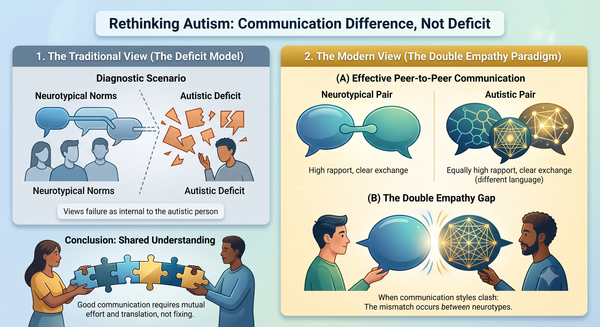
This is a translation problem, not a thinking problem

Literal language processing is well-documented in Autistic neurology. It’s not a deficit. It’s a different relationship with words — one that takes language at face value rather than filtering it through layers of assumed social context that nobody ever actually explains out loud. (Weird system, honestly.)

Most neurotypical communication runs on implication. Words are placeholders for approximate meanings, and the “real” message lives somewhere between the lines. People learn those unspoken rules early, usually without knowing they’re learning them at all. It’s like everyone got a manual and then forgot they had it.

Autistic brains often process language more precisely. When someone asks “did you do your best,” the brain goes to work on what that phrase actually contains. Best as in maximum capacity. Best as in every available resource. That’s what the words say.

What they mean, in common usage, is closer to: “did you make a reasonable effort?” Which is genuinely a different question. A much smaller question. One you probably could have said yes to.

Neither reading is wrong. But only one is recognized as correct in most social contexts — and it’s usually not the literal one.


The gap is real. And it shows up everywhere.

A few more that might feel familiar:

“Just be yourself.”

Woman with orange glasses makes funny face through peephole
Photo by Tanya Barrow on Unsplash

What it sounds like: Perform a complete inventory of every trait you possess, then display all of them simultaneously, in every setting, regardless of audience or consequence.

What they mean: Don’t perform a version of yourself just to impress people.

(Which, fair. But “be yourself” is doing a lot of heavy lifting for a three-word sentence.)


“Give 110%.”

person in black shirt holding white paper
Photo by Ryan Snaadt on Unsplash

What it sounds like: Exceed the mathematical limits of human output. Somehow generate more than everything you have.

What they mean: Try hard. Care about what you’re doing.

(The math has never worked. We’ve all just agreed to let it go.)


“Let me know if you need anything.”

man in white button up shirt holding black and white box
Photo by Jessie McCall on Unsplash

What it sounds like: An open, unconditional offer covering any conceivable need, at any time, with no limits and no expiration date.

What they mean: I care about you. I wanted to say something kind. If something concrete and obvious comes up, I’m willing to help.

(Taking this literally, by the way, does not go the way you’d hope. Ask me how I know.)


“Keep an open mind.”

a pair of glasses
Photo by Kelsy Gagnebin on Unsplash

What it sounds like: Suspend all prior knowledge, experience, and critical thinking. Accept incoming information without evaluation or skepticism, indefinitely.

What they mean: Hear this out before you decide what you think about it.

(Reasonable request. Unreasonably worded.)


“You can do anything you set your mind to.”

man holding lighted art
Photo by Aditya Saxena on Unsplash

What it sounds like: Ability, access, circumstance, and biology are irrelevant. Pure intention is the only variable that matters.

What they mean: Don’t give up just because something is hard or unfamiliar.

(A genuinely nice sentiment wrapped in a statement that is demonstrably false. We persevere.)


“You should smile more.”

a boy smiling for the camera
Photo by Silvana Carlos on Unsplash

What it sounds like: Maintain an upward facial expression continuously, regardless of internal state, context, or social logic.

What they mean: I’m more comfortable when you look happy.

(This one really is just about them. You were right to be confused.)

Each of these is a small collision between two different systems of meaning. And for people who process language literally, these collisions happen dozens of times a day. It gets exhausting — not because something is wrong with you, but because you’re doing twice the work just to figure out what anyone actually meant.


What I want you to hear

If you’ve spent your life feeling like you keep getting the answer wrong — like you respond to what was actually said and somehow that’s still the problem — you’re not confused. You’re precise.

The issue isn’t your comprehension. It’s that most communication is built on assumptions that were never made visible to you. And when you operate without those hidden rules, you look like you’re missing something. You’re not. You’re just working with what’s actually there.

This has a name. Literal language processing is a recognized feature of Autistic cognition. You’re not failing to understand. You’re understanding something slightly different — something more exact — than what was intended.

That’s not a deficit. It’s a different operating system, running in an environment that wasn’t designed for it. Which is a frustrating place to be, but it is not a “you” problem.


A note for non-Autistic readers

If someone in your life takes your words more literally than you intended — a colleague, a partner, a kid, a client — this is worth understanding.

They’re not being difficult. They heard what you said, processed it carefully, and responded to it honestly. That is, arguably, exactly what language is for.

The gap isn’t theirs to close alone. Saying what you actually mean — “did you make a reasonable effort?” instead of “did you do your best?” — isn’t a burden. It’s just clearer. And clearer is better for everyone, whether or not anyone’s Autistic.


This is me.

From where I sit

I’m AuDHD. Late diagnosed. And I have spent a significant portion of my life discovering, in retrospect, that I answered the wrong question — not the one being asked, but the one that was actually said.

It took a long time to stop treating that as a personal failure. Turns out it wasn’t. It was just a translation problem. A chronic, exhausting, completely invisible translation problem that nobody around me knew was happening, including me.

The world runs on approximations. I’m wired for precision. Those two things create friction — but friction isn’t the same as failure. It just means you’re working harder than most people realize, in a language that wasn’t built for the way your brain works.

If this lands for you: the way you process language is legitimate. You’re not broken. You’re fluent in a dialect most people don’t realize they’re not speaking.


Want to go deeper?

Literal language processing is just one piece of how Autistic cognition works — and there’s genuinely good research on it. If you want to understand more about Autistic communication styles, monotropism, and why the neurotypical social rulebook feels like it’s written in a foreign language, a few places worth exploring:

  • Unmasking Autism by Devon Price
  • The Autistic Self Advocacy Network (autisticadvocacy.org)
  • The work of Dr. Damian Milton, particularly his writing on the Double Empathy Problem

And if you’re looking for support from someone who gets it — not just professionally, but personally — I’d love to connect.

I’m Rachelle Goldenberg, LCSW, the CEO and clinician of Swift Mind Care, a California-based therapy and consulting practice specializing in neuroaffirming care for Autistic and ADHD adults. I work with late-diagnosed individuals navigating exactly this kind of lifelong “wait, was I doing that wrong?” reckoning.

You can find more at swiftmind.substack.com or reach out directly through SwiftMindCare.com.