We Keep Asking the Most Vulnerable People to Do the Most Bending

There’s a pattern I see everywhere — in schools, workplaces, families, therapy waiting rooms, and healthcare systems. And once you see it, you genuinely cannot unsee it.
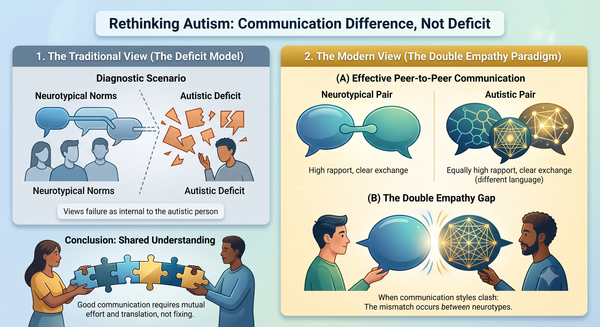
We consistently ask the person with the least capacity, the least power, and the least support to make the biggest accommodations for everyone else.
Not the person with the most resources. Not the system with the most flexibility. The one who’s already stretched.
The Autistic Child Who Has to Tolerate the Classroom
Picture a kid whose nervous system is genuinely overwhelmed by fluorescent lights, background noise, and unpredictable transitions. The environment wasn’t built for them — it wasn’t even considered. And yet the intervention plan is almost always focused on the child. How can they cope better? How can they self-regulate more? How can they fit?
Rarely does anyone ask: what if we just... turned the lights down?
The same thing happens with the ADHD adult at work who gets told to “try being more organized” — as if willpower is the missing ingredient, as if the open-plan office buzzing with interruptions isn’t a genuinely hostile environment for an executive function difference. Or the person with depression who keeps showing up, keeps producing, keeps holding it together — because letting the mask slip even slightly feels like burdening everyone around them.
The person doing the most invisible labor is almost always the one with the most to lose if they stop.
This Isn’t Personal. It’s Structural.
Neurodivergent people aren’t accommodating everyone else because they’re people-pleasers by nature (though many are, because they learned to be). They do it because the message was delivered early and often: your needs are the problem. Your discomfort is optional. Everyone else’s comfort is not.
Masking starts young. Autistic kids learn that stimming makes people uncomfortable. ADHD kids learn that their natural rhythms are disruptive. Anxious kids learn that their feelings are too big. And so they shrink. They adapt. They become experts in anticipating and absorbing everyone else’s needs — while their own go unmet, unnamed, and often unrecognized even by themselves.
This is what I’d call internalized responsibility — the deep, often unconscious belief that it is your job to make sure no one around you is inconvenienced by your existence. It’s not a character flaw. It’s a survival strategy. One that costs an enormous amount to maintain.
What That Costs
Because there is a cost. Always.
Chronic burnout isn’t just tiredness. It’s what happens when a nervous system has been in performance mode for so long that it loses access to genuine rest. It’s the exhaustion of being “on” in every room, every relationship, every interaction — of translating yourself constantly for people who never had to learn your language.
It shows up as identity confusion: Who am I when I’m not managing everyone else’s experience of me? It shows up as a flattened capacity for joy, because the energy that should go toward creativity and connection has been rerouted into compliance. It looks like anxiety that won’t quiet down. Depression that doesn’t have a “reason.” A bone-deep sense of being too much and not enough, simultaneously.
And underneath all of it, often: a person who has bent themselves into shapes they were never meant to hold. For so long they’ve forgotten what their natural shape even is.
Why Systems Don’t Change
Here’s the uncomfortable part. Systems don’t change because change is inconvenient for the people who benefit from them staying the same.
When neurotypical ways of communicating, organizing, learning, and working are treated as the default — as neutral, as normal — then any deviation from that becomes the problem to be fixed. Not the system. The person.
And neurodivergent needs, which are real and valid and structural, get filed under “special requests.” Optional. Extra. A burden. Something to be accommodated only when someone advocates loudly enough, documents thoroughly enough, and makes the case convincingly enough — usually while already running on empty.
We’ve also confused “fair” with “equal.” Equal means everyone gets the same thing. Fair means everyone gets what they need. Those are not the same. And until systems understand that distinction, they’ll keep asking the people with the least to give the most.
What It Looks Like When We Get It Right
It’s actually not that complicated — though it does require a shift in who carries the responsibility.
The most sensitive nervous system sets the baseline for the environment. Lighting, noise levels, and predictability aren’t accommodations; they’re design choices. The more regulated person takes the lead in repair during relational conflict. The workplace builds scaffolding around executive function realities instead of expecting willpower to fill the gap. Healthcare providers slow down, adjust their communication, and stop requiring patients to perform wellness in order to receive care.
The person with the most resources makes the biggest adjustment. That’s it. That’s the whole model.
It requires something that our systems are deeply uncomfortable with: humility from those who’ve never had to adapt, and trust that the people who’ve been adapting their whole lives actually know what they need.
For Anyone Who Recognizes Themselves Here
If you’ve been the person doing all the bending — the one who’s always managed, always adjusted, always found a way to make it work for everyone else — I want to name something clearly:
That was never a personality trait. It was a response to a world that asked too much of you, too early, with too little support.
Your needs were never the problem. The gap between what you needed and what was offered — that’s the problem.
You don’t have to keep contorting yourself to fit spaces that weren’t built with you in mind. And the fact that you’ve survived in them this long isn’t proof that you didn’t need anything different. It’s proof of how hard you’ve been working.
The people who’ve been asked to accommodate the most deserve to be accommodated — fully, structurally, without having to justify it.
It’s past time for the systems to start doing the bending.
If this resonated with you, share it with someone who needed to read it — or someone who needs to understand it.