What Autism Actually Looks Like

Neurodiversity · Understanding Autism

Share
What Autism Actually Looks Like

Most people know the surface. Here’s what’s underneath — the experiences that shape daily life and almost never make it into the conversation.

Neurodivergence is a different set of wiring.

Autism isn’t one experience. It’s many — and most of them are invisible.

What follows isn’t a checklist of deficits. It’s a map of how a differently wired nervous system moves through a world that wasn’t designed for it. Some of these will resonate immediately. Others might finally put language to something that’s been hard to explain.

For executives, clinicians, and leaders: this is also a window into what your colleagues, clients, and team members may be navigating — quietly, competently, and often at significant personal cost.

“There is no single way to be autistic. The presentations are too varied, the internal experiences too different.”


🧠 How the Brain Processes Information

Alexithymia
Emotional processing

Difficulty identifying or describing your own emotions. This isn’t emotional unavailability. It’s more like the signal exists but the label doesn’t load. You might know something feels wrong without being able to name it, or realize you’ve been stressed only after your body shuts down.

Therapy, relationships, and self-awareness all get harder when you can’t access that internal vocabulary.

Context Blindness
Social inference

Difficulty using context to infer meaning. Most communication is implied. People expect you to read the room, fill in the gaps, and know what wasn’t said. For autistic people, that inferencing process doesn’t happen automatically. It takes deliberate effort — and even then, the meaning isn’t always clear.

This gets misread as rudeness or obliviousness. It’s neither.

Literal Processing
Language & communication

Taking language at face value. Sarcasm, idioms, implied meaning, and social subtext often don’t land the way they’re intended. This isn’t naivety. It’s a different relationship with language — one that values precision and finds vagueness genuinely confusing.

In professional settings, this can look like missing the point. Often, the autistic person understood exactly what was said. Just not what was meant.

Hyperlexia
Reading & comprehension

Advanced reading ability, often paired with differences in comprehension. Reading the words and understanding the meaning are two separate skills. Hyperlexic individuals may read fluently and early, while still working to extract deeper meaning from what they’ve read.

In educational settings, this gets missed constantly because the surface skill looks like mastery.

Monotropism
Attention & focus

An intense focus on one interest or task at a time, creating deep attention tunnels that make switching genuinely painful. The brain isn’t designed to context-switch easily. When attention is locked in, pulling out of it isn’t just inconvenient — it can feel like being dragged away from something essential.

The flip side is that monotropic focus produces a depth of knowledge and engagement that’s hard to replicate.


⚡Executive Function & Time

Executive Function Differences
Planning & initiation

Difficulty with planning, initiating tasks, sequencing steps, and transitioning between activities. This is often the gap between knowing what needs to be done and actually being able to start it. High intelligence doesn’t protect against this.

Many autistic adults describe knowing exactly what they should do while being genuinely unable to begin. It’s not laziness. The ignition system works differently.


Working Memory Differences
Cognitive load

Difficulty holding information in mind while using it. Conversations, multi-step instructions, and complex tasks all rely heavily on working memory. When it’s unreliable, people look forgetful or disorganized — not because they aren’t paying attention, but because the mental whiteboard clears faster than expected.

Time Blindness
Time perception

Difficulty perceiving and tracking the passage of time. Time can feel binary: now or not now. The hours in between don’t always register the way they do for others.

This affects deadlines, transitions, and self-pacing in ways that consistently get misread as irresponsibility or lack of care.

Demand Avoidance
Nervous system response

A strong nervous system response to demands or expectations. This isn’t defiance. The nervous system registers demands — even reasonable ones, even self-imposed ones — as threats. The resistance that follows is physiological before it’s behavioral.

Understanding this changes how you approach support, structure, and goal-setting entirely.


“What reads as indifference is often hypervigilance. What seems like a quirk is often a coping strategy that’s been running quietly for years.”

👂Sensory Experience


Auditory Filtering Differences
Sound processing

Difficulty tuning out background noise, where everything comes in at the same volume. Most brains filter automatically, pushing ambient sound to the background. For many autistic people, that filter works differently. A conversation, the AC, someone typing, a TV in the next room — it all lands with equal weight.

Concentration and presence become effortful in ways that are invisible to everyone else in the room.


Synesthesia
Sensory crossover

Sensory crossover — such as seeing colors when hearing sounds, or associating numbers and letters with colors or textures. The senses don’t always stay in their lanes. This can be subtle or vivid, useful or disorienting. It’s more common in autistic and neurodivergent people than in the general population, and it shapes how information is processed and remembered.

Sensory Seeking
Regulation

The flip side of sensory sensitivity. Some autistic people actively seek intense sensory input — tight pressure, loud music, strong tastes, repetitive movement. Stimming — repetitive movement or sound — often serves the same purpose.

This is regulation, not impulsivity. The nervous system is looking for something it needs. It’s not a behavior to eliminate. It’s a tool.


🧍Body Awareness & Physical Experience

Interoception Differences
Internal signals

Difficulty sensing internal body signals like hunger, thirst, pain, or the need to use the bathroom. Many autistic people don’t notice they haven’t eaten all day, or realize they’re in pain only after it becomes severe.

This affects health, self-care, and daily functioning in ways that go largely unrecognized — including by the person experiencing them.

Proprioception Differences
Spatial awareness

Reduced awareness of where your body is in space. This shows up as clumsiness, difficulty with physical coordination, bumping into things, or not knowing how much pressure you’re applying. It’s not carelessness. The feedback loop between body and brain is calibrated differently.

Echolalia
Language & regulation

Repeating words or phrases to process, communicate, or regulate. Sometimes it’s immediate. Sometimes it’s delayed, pulling from something heard days ago. Echolalia serves real functions: it can be a way of responding when words don’t come, a way of self-soothing, or a way of processing something that hasn’t fully landed yet.

It’s language doing what it can with what’s available.

Prosopagnosia
Face blindness

Difficulty recognizing faces, even familiar ones — relying on voice, gait, hair, and context instead. Without those cues, recognition fails, even with people known well. This creates real social friction that gets interpreted as inattention or coldness.

It’s not. The brain is just navigating recognition through a different route.


🤝Social Experience & Identity


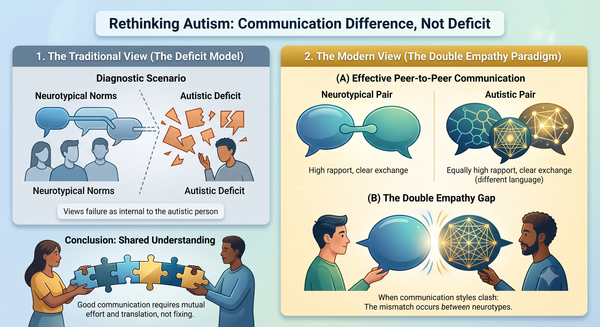
The Double Empathy Problem
Research-backed

The finding that communication breakdowns between autistic and non-autistic people go both ways. Non-autistic people also misread autistic social cues — they just aren’t the ones asked to change. The deficit framing has historically only pointed one direction.

This reframe matters. It shifts the conversation from “what’s wrong with autistic people” to “what happens when two different neurotypes try to connect without a shared framework.”


Masking / Camouflaging
Identity & survival

Suppressing or hiding autistic traits to appear neurotypical. This is exhausting, identity-eroding work. It’s linked to burnout, anxiety, depression, and delayed diagnosis — especially in women, girls, and people of color, who are often socialized to mask more completely and for longer.

The cost of masking is rarely visible until it isn’t sustainable anymore.


🔋Nervous System & Regulation


Autistic Burnout
Capacity & recovery

A period of profound exhaustion, withdrawal, and loss of skills that follows prolonged stress or sustained masking. This is distinct from depression, though it can look similar. Skills that were previously accessible — communication, self-care, executive function — can temporarily disappear.

Recovery takes longer than most people expect, and pushing through typically makes it worse. Rest isn’t optional here. It’s the treatment.


Meltdowns & Shutdowns
Overwhelm response

When the nervous system takes in more than it can process — sensory input, social demands, transitions, unexpected change — the result can be a meltdown or shutdown. A meltdown is an outward release of that overload. A shutdown is an inward one: going quiet, withdrawing, becoming unreachable.

Neither is a tantrum or manipulation. Both are the nervous system doing what it has to do when it’s exceeded its capacity.


So what is this all about? Why share it?

white and pink number 10
Photo by Peter Burdon on Unsplash

Awareness is a start. But without understanding and genuine acceptance, it stays surface level.

There is no single way to be autistic. The presentations are too varied, the internal experiences too different. What looks like confidence in one person looks like shutdown in another. What reads as indifference is often hypervigilance. What seems like a quirk is often a coping strategy that’s been running quietly for years.

Beneath the surface, we’re all more layered than we appear.