When the Pain Feels Too Big for the Moment
...or is it RSD?

Receiving a mildly critical email at work can sometimes lead to hours of overanalyzing and catastrophizing, creating the belief that one’s professional future is in jeopardy. Similarly, when a friend leaves a message unread, it can prompt an immediate spiral into imagining the end of the relationship. Even hearing the phrase “we need to talk” can evoke intense anxiety, causing a visceral reaction before any actual discussion has taken place. Have you ever wondered why it feels SO heavy?
That’s not you being “too sensitive.” That might be Rejection Sensitive Dysphoria (RSD)— and there’s a name for it because it’s real, it’s neurological, and it affects a lot of us.
So what actually is RSD?
Rejection Sensitive Dysphoria (RSD) is an intense, often overwhelming emotional response to real or perceived rejection, criticism, failure, or disapproval. The key word there is perceived — your nervous system doesn’t wait for confirmation. It just fires.
The “dysphoria” part of the name comes from the Greek word literally meaning unbearable. That’s not hyperbole. People who experience RSD often describe it as a physical sensation — like being punched in the chest, like an open wound. The emotional pain is genuinely that intense, and it’s genuinely disproportionate to what actually happened.
This is what separates RSD from everyday rejection sensitivity. Most people feel bad when they’re rejected or criticized. With RSD, that feeling can be so extreme it stops you from functioning — sometimes for hours, sometimes longer. One moment you’re fine, and then something triggers it and you’re in emotional freefall.
And here’s the part that doesn’t get talked about enough: the shame spiral that follows. Because you know on some level that the reaction doesn’t quite fit the situation. That awareness doesn’t make the pain smaller. It just adds a layer of “what is wrong with me” on top of everything else.
Who tends to experience RSD?
RSD isn’t an official DSM diagnosis, but it’s widely recognized as one of the most disruptive features of emotional dysregulation — and it shows up most commonly in people who are already wired for big emotions.
ADHD is where RSD was first really studied and named, largely through the work of Dr. William Dodson. Research suggests that somewhere between 20–30% of people with ADHD experience RSD, and for many of them, it’s actually more impairing than the attention or hyperactivity symptoms. The connection makes sense neurologically — the ADHD brain processes emotion differently, with different connectivity between the prefrontal cortex and the amygdala. The parts of the brain that are supposed to help regulate emotional responses are working differently, not deficiently. They’re just wired in a way that makes emotion hit harder and faster.
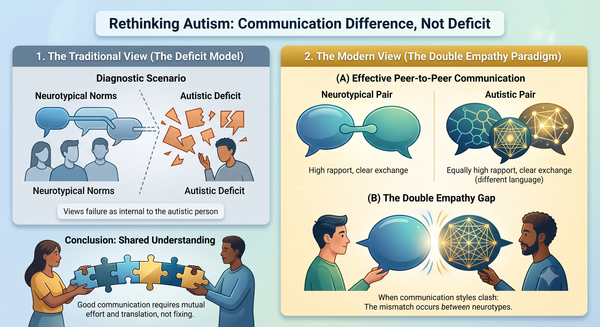
Autism is another condition closely associated with RSD. Autistic individuals often already navigate a world that sends mixed or confusing social signals, which makes perceived rejection a more frequent experience. When RSD is layered on top of that, the emotional fallout can be significant.
Beyond those two, RSD also appears in people with:
- Borderline Personality Disorder (BPD) — where fear of abandonment and intense emotional responses are central features
- Complex PTSD (C-PTSD) — especially when there’s a history of relational trauma, criticism, or emotional invalidation
- Anxiety disorders — particularly social anxiety, which overlaps in the anticipation of rejection
- Depression and mood disorders — where emotional regulation is already compromised
- PTSD more broadly, especially when hypervigilance extends to social and relational cues
If you’ve ever been told you’re “too sensitive,” “too much,” or that you need to “calm down” — and you’ve internalized that as something being fundamentally wrong with you — there’s a good chance RSD has been part of your experience for a long time. You probably just didn’t have a name for it.
What does it actually look like in real life?
RSD doesn’t look the same for everyone. Some people explode outward — sudden anger, emotional outbursts, saying things they regret. Others implode — withdrawing, going quiet, disappearing. Some people develop elaborate avoidance strategies to never put themselves in situations where rejection is possible. Some become relentless people-pleasers, scanning every interaction for signs of disapproval and preemptively trying to neutralize it.
Some common signs to watch for:
- Replaying conversations obsessively, looking for the moment you “said something wrong”
- Assuming the worst when someone is quiet, distant, or vague
- Feeling completely devastated by criticism that others seem to brush off easily
- Avoiding opportunities — jobs, relationships, creative projects — because the risk of failure or rejection feels unbearable
- People-pleasing to the point of losing track of what you actually want
- An emotional reaction that hits instantly, like a switch being flipped
- Intense shame about how intensely you reacted
That last one is important. The shame about the shame is a real part of this experience.
RSD and relationships — the part that gets really complicated
This is where RSD tends to do some of its most lasting damage, and also where understanding it can genuinely change things.
When you live with RSD, relationships — all of them, not just romantic ones — carry a kind of background static that most people don’t have to deal with. Every interaction has a little bit of risk loaded into it. A friend who’s quieter than usual, a partner who seems distracted, a colleague who didn’t respond to your message the way you expected — any of these can quietly launch your nervous system into threat mode. You might not even realize it’s happening until you’re already deep in a spiral.
In long-term relationships, this can show up as needing a lot of reassurance. Not because you’re clingy or insecure at your core, but because your brain genuinely does not hold onto “I am safe here” the way a non-RSD brain might. The reassurance resets the threat response. It works — until it’s needed again. And over time, that cycle can be exhausting for everyone involved, including you.
There’s also the flip side, which is emotional shutdown. Some people with RSD reach a point where the risk of getting close feels like too much, so they pull back preemptively. Better to create some distance than to wait for the rejection that feels inevitable. It protects you in the short term. In the long term, it keeps you from the connection you actually want.
Meeting new people when your brain is already on high alert
Starting new relationships — friendships, romantic connections, even professional ones — is genuinely harder when you have RSD. And that’s worth naming directly, because a lot of us have spent years thinking we’re just bad at this, or that something’s wrong with how we connect with people.
Here’s what’s actually happening: when you meet someone new, your brain is already running a quiet background program asking are they going to reject me? Did I say the wrong thing? Did that land weird? Do they actually like me or are they just being polite? Most people have a version of that. With RSD, it’s louder, faster, and it doesn’t require any actual evidence of rejection to get going.
So you might come home from a first hangout that went completely fine and spend two hours analyzing every moment of it. Or you might really like someone and hold back, because the more you care, the higher the stakes feel. Or you might overshare early on — almost like trying to fast-track to the part where you know if it’s safe — and then feel exposed afterward.
None of this is a character flaw. It’s your nervous system trying to protect you with tools that aren’t quite calibrated for the situation.
A few things that have genuinely helped people navigate new connections with RSD:
Be honest about it — when it feels right. You don’t have to disclose on day one, but giving people some context when you’re starting to trust them can shift a lot. Something as simple as “I sometimes read into things more than I should — if something’s off between us, I’d always rather you just tell me directly” opens a door. Most good people will meet you there.
Watch for the urge to test. RSD can create this impulse to find out early whether someone will reject you — sometimes unconsciously pushing a little to see how someone responds. It makes total sense as a coping strategy. It also tends to create exactly the friction you were afraid of. Noticing the urge without acting on it is its own form of progress.
Slow down the story your brain is telling. When you don’t hear back from someone new and your brain starts writing a whole narrative about what it means — pause and just ask: what’s the most boring explanation here? They’re busy. They forgot. Their phone is in another room. Boring is almost always more accurate than the catastrophic version.
Find your people. Honestly, one of the most relieving things you can do is find communities — online, in person, wherever — where neurodivergent experiences are normal and understood. When you’re around people who get it, the risk-to-connection ratio shifts. You don’t have to spend as much energy managing how you come across, and genuine closeness gets a lot more accessible.
The part nobody talks about enough: don’t make decisions when you’re in it
This is probably the most practical thing I can share.
When RSD hits — when you’re in that state of overwhelming emotional pain — your brain is not in a position to make good decisions. The emotional flooding is real. Your threat-response system has essentially taken over, and the part of your brain responsible for perspective, nuance, and long-term thinking is not running the show right now.
What happens during an RSD episode if you try to make decisions? You might quit a job because of one bad interaction. End a relationship over a misread text. Send a message you’ll deeply regret. Withdraw from something meaningful because the fear of further pain feels too big.
These decisions feel completely rational in the moment. They feel necessary. They feel like the only logical response to the situation. That’s how convincing the emotional state is.
But they’re being made from a place of pain, not clarity.
So the practice — and it is a practice, not a perfect science — is to buy yourself time. If you can recognize that you’re in an RSD episode, that recognition alone is actually powerful. It lets you shift from “this is real and I need to act on it right now” to “I am having an RSD response, and I need to wait before I do anything.”
Some things that can help in the moment:
Name it. “I’m having an RSD response right now.” You don’t have to believe the feelings are wrong or invalid. You’re just labeling what’s happening in your nervous system.
Buy time on decisions. A simple rule: if you’re flooded, you don’t send the email, don’t have the big conversation, don’t make the call. Give yourself a minimum of 24 hours — more if you can. The decision will still be there when your nervous system has regulated.
Move your body. This is one of the most underrated tools. Physical movement helps process the adrenaline and cortisol that flood your system during an emotional dysregulation episode. A walk, stretching, even just standing up and shaking out your hands.
Ground yourself physically. Cold water on your face or wrists, deep slow exhales (the exhale matters more than the inhale for calming your nervous system), something to hold in your hands.
Reach for self-compassion, not self-correction. This is not the moment to analyze what’s wrong with you. That analysis can come later, and it’s more useful when you’re calm. Right now, you just need to get through the wave.
The wave always passes. It doesn’t feel like it will, but it does.
A note on getting support
RSD responds well to the right kind of support. Some people find medication helpful — particularly alpha agonists like guanfacine, which were originally prescribed for ADHD and blood pressure but have shown real benefit for emotional regulation and RSD specifically. This is worth talking to a prescriber about, especially if you also have an ADHD diagnosis.
Therapy approaches that address emotional regulation — DBT (Dialectical Behavior Therapy), trauma-informed therapy, and IFS (Internal Family Systems) — can be really meaningful for understanding and working with your RSD patterns rather than fighting them.
And community. Finding people who get it — who don’t tell you you’re overreacting, who understand what “the wave” feels like — matters more than we often give it credit for.
You’re not broken. Your nervous system is doing exactly what it was wired to do — it’s just doing it at a volume that makes daily life harder than it needs to be. That’s worth addressing, not because something is wrong with you, but because you deserve to move through the world with a little more ease.
The feelings are real. The pain is real. And you don’t have to make permanent decisions from temporary pain.
If you think RSD might be part of your experience, talking to a mental health professional who understands neurodivergence is a great starting point. You don’t have to figure this out alone.
The two new sections are fully integrated — let me know if you want to dial up the personal voice anywhere, add a specific story or example, or shift the tone in the relationships section to feel more like your own lived experience.