Why My Face Looks Like That
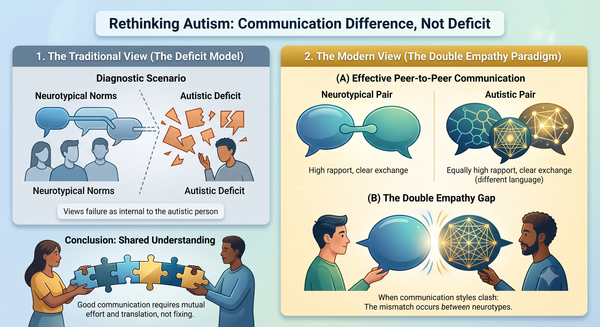
The story of "RBF" is a common theme in Autistic females.

I don’t have a day go by that I don’t get asked “what’s wrong” when I’m just sitting there. I remember being told I was stuck up, or giving the “stink eye” when I was a teen, when I had literally no intention. I have had workplace incidents where the assumption was that I wasn’t a team player (to be fair, I’m not a fan of team projects because I tend to like to work on things at my own speed)….but the reality was I was just listening and fidgeting because sitting around in a circle or at a table isn’t my way of processing. If this resonates, you may get this. When I was diagnosed with Autism that was step 1, when I got further clarification with ADHD that clarified it more…and as a female who is AuDHD, this story isn’t unique. It’s literally the story I hear from clients and people who reach out to me here all the time.
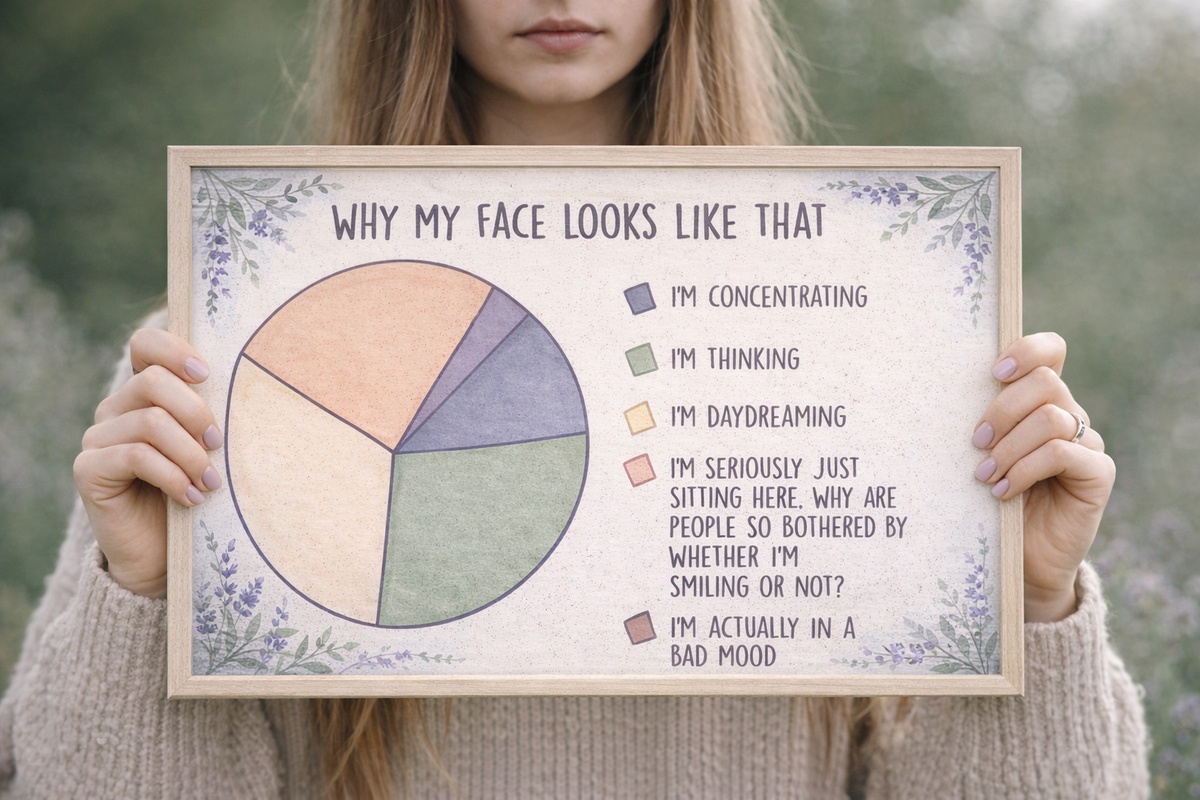
The meme that keeps on meme-ing
There’s a meme format that keeps circulating online. A pie chart. The title changes depending on the version, but the slices stay the same: concentrating, thinking, daydreaming, seriously just sitting here (why are people so bothered by whether I’m smiling or not?), and — the smallest sliver — actually in a bad mood.

It lands because it’s true. And for a lot of autistic people, it’s not just relatable content. It’s a daily reality they’ve been trying to explain for most of their lives.
The assumption problem
Most people read faces the way they read road signs — quickly, automatically, and with a lot of confidence. A neutral expression gets coded as unfriendly. A flat affect gets read as rude or cold. A resting face that doesn’t perform warmth on cue gets treated like a problem that needs solving.
And here’s where it gets costly: when someone assumes the worst about what your face means, they stop responding to you. They start responding to the story they made up about you.
They get offended. They pull back. They decide you don’t like them, or that you’re difficult, or that something must be wrong. All of this, without ever asking.
“When one assumes, they make an ASS out of U and ME”
Someone once upon a time ago said it
Facial expressions and autism
For many autistic people, there’s a real gap between internal experience and outward expression. Someone can be genuinely engaged, content, or completely at ease — and their face simply won’t show it the way a neurotypical person’s would. This isn’t concealment. It’s not indifference. It’s just how their nervous system works.
The reverse is also true. Some autistic people express emotion more intensely than the moment seems to call for, or in ways that feel mismatched to the people around them. Both get misread.
This is sometimes called flat affect, and it has nothing to do with emotional depth. Many autistic people feel things very deeply. Their faces just don’t always broadcast it in the format others are looking for.
The cost of assuming the worst
When we default to the most negative interpretation of someone’s expression, we’re making a choice — even when it doesn’t feel like one.
That choice has consequences. It shapes how autistic employees get evaluated. How autistic kids get treated in classrooms. How autistic adults get perceived in conversations where they’re genuinely trying to connect.
“You don’t look happy to be here.” “You seem upset about something.” “Why do you always look so serious?”
These aren’t neutral observations. They’re corrections. And over time, they teach people to mask — to perform an expression that feels unnatural and exhausting, just so the people around them feel comfortable.
The burden lands entirely on the wrong person.
What it actually looks like to assume the best
Assuming the best doesn’t mean ignoring genuine distress. It means pausing before you interpret.
It means asking instead of concluding. “Hey, you seem quiet — everything okay?” lands very differently than “You seem annoyed with me.” One opens something. The other shuts it down.
It means accepting that a neutral face is not a hostile face. That someone who isn’t smiling isn’t necessarily unhappy. That concentration, calm, and deep thinking don’t always look the way we expect them to.
And it means sitting with the possibility that you might not be able to read someone accurately — and that this is your gap to manage, not theirs to perform around.
A note for autistic readers
If you’ve spent years being told your face says the wrong thing, you already know how wearing that is. You weren’t broken. You were being measured against a standard that was never designed with you in mind.
Your face doesn’t owe anyone a performance. Your calm is not coldness. Your focus is not rudeness. And the fact that you’ve had to explain this over and over — in jobs, in relationships, in rooms where you were just trying to show up — is a specific kind of exhaustion that doesn’t always get named.
Most of the time, you really are just sitting there. Thinking. Concentrating. Doing your thing.
That’s enough.
Rachelle Goldenberg is a Licensed Clinical Social Worker and CEO of Swift Mind Care, a clinical practice specializing in neuroaffirming therapy for adults in California. Her work centers on helping neurodivergent people understand themselves more clearly — and helping the world around them do the same.
If this resonated with you, subscribe to this Substack for more writing on neurodiversity, autism, ADHD, and what it means to live and work as a neurodivergent adult. For information about therapy services, visit swiftmind.care.