You Were Given the Wrong Map

What's Actually Happening When Standard Regulation Advice Fails AuDHD Nervous Systems

Share
You Were Given the Wrong Map
Photo by Odalv on Unsplash

Something I hear constantly from AuDHD people — especially those who are newly identified — is that they've spent years doing everything they were told to do to manage their nervous systems. And they feel worse for it. Not better. Worse. Then they spend even more energy trying to figure out what's wrong with them, because the things that help everyone else are actively making things harder.

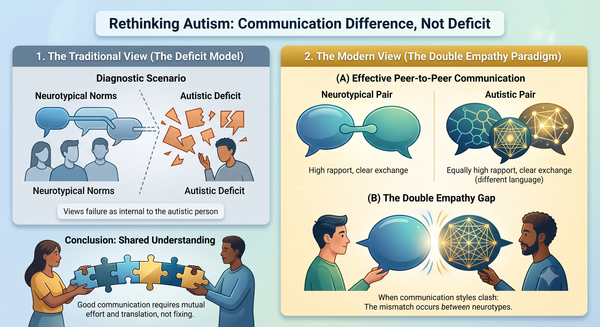
The answer isn't that something is wrong with them. The answer is that the regulation toolkit most of us were handed was built for a nervous system that is not ours.

This matters more than it sounds like it should. When you spend years applying the wrong interventions to your nervous system and experiencing the predictable result — that they don't work — you don't conclude that the interventions are wrong. You conclude that you are. That you're too anxious, too resistant, too undisciplined, too something. The problem gets located in you rather than in the mismatch between your neurology and the advice you received.

That misattribution does real harm over time. It compounds the self-blame that most late-identified AuDHD people are already carrying in significant quantities. And it keeps people stuck, trying harder at tools that were never designed for how their nervous system actually works.

This piece is about what's actually happening when standard regulation advice fails AuDHD people. Not at the surface level of "everyone is different" — but at the level of what AuDHD nervous systems are actually doing, why the typical interventions work against rather than with those nervous systems, and what to try instead.

AuDHD Dysregulation Doesn't Move in One Direction

That's the core thing. A nervous system that is simultaneously managing autistic sensory processing, monotropic attention, interoceptive gaps, ADHD dopamine dynamics, and interest-based activation is not going to respond reliably to tools designed for a system that dysregulates in one predictable way.

Sometimes what looks like overactivation is actually underload. Sometimes what looks like a need for quiet is actually a need for the right kind of input. Applying subtraction to a nervous system that needs addition makes things worse — and most standard regulation advice is built around subtraction.

Your brain isn't broken for seeking dopamine. It's a human nervous system trying to regulate itself in an environment that's often overstimulating and under-nourishing at the same time. The goal isn't to eliminate the need for regulation — it's to build a toolkit that actually fits how your brain is organized.

Part One: Reframes

A lot of the work here is perceptual before it's practical. Getting out from under the assumption that the standard toolkit should work if you just try harder is its own significant task. These reframes aren't affirmations — they're more accurate descriptions of what's actually happening.

"I'm bad at regulating" → "I've been using the wrong tools"

The standard toolkit wasn't designed for a nervous system managing both autistic and ADHD processing simultaneously. Failure to respond to those tools isn't a personal failing — it's a mismatch. That distinction matters a lot when you're trying to build something new.

"I need to calm down" → "I need to find the right input"

Calm isn't always the goal. Sometimes your nervous system is dysregulated because it's underloaded — it needs more of the right kind of stimulation, not less. The question isn't always "how do I reduce this?" but "what is my system actually asking for right now?"

"I can't stop" → "My system is still seeking something it hasn't found yet"

Looping, perseverating, or being unable to move on aren't signs of weakness or poor self-control. They're often signs that something unmet — a sensory need, a dopamine deficit, an unprocessed emotion — is still running in the background. Addressing the root is more effective than white-knuckling through the symptoms.

"What's wrong with me?" → "What does my nervous system need right now?"

This shift is deceptively simple and genuinely difficult to make after years of internalizing the wrong answer to that question. But it moves you from self-blame into curiosity — and curiosity is where actual problem-solving lives.

"I should be able to do this alone" → "Co-regulation is a legitimate strategy, not a dependency"

Human nervous systems are designed for co-regulation. AuDHD nervous systems in particular often regulate better with the right kind of relational support — not because something is wrong with them, but because that's how nervous systems work. Needing support isn't a failure of self-sufficiency. It's neurobiology.

Wooden blocks with smiley faces ascending towards a lightbulb.
Photo by Sasun Bughdaryan on Unsplash

Part Two: What to Try Instead

These aren't on the usual recommendation lists. They work specifically because of how AuDHD nervous systems are organized — not in spite of it.

Stimulation that matches your current state

When you're underloaded, trying to "calm down" can make things significantly worse. Movement, sound, texture, rhythm — the right sensory input can regulate a nervous system that needs addition, not subtraction. This might look like music with a strong beat, pacing, weighted input, or something with high sensory interest. There's no wrong answer here, only what your system actually responds to.

Task-switching as a regulation tool

For some AuDHD nervous systems, being stuck in dysregulation can be interrupted not by stillness but by a complete context shift. Moving to a different task, environment, or sensory experience can break the loop in a way that deep breathing simply can't. Giving yourself permission to step away from what you're supposed to be doing — without guilt — is sometimes the most effective regulation strategy available.

Interest-based anchoring

ADHD nervous systems are interest-based, not importance-based. Trying to regulate through tasks or activities that feel boring or neutral often doesn't work because there's not enough dopamine available to sustain it. Leaning into something that genuinely interests you — even briefly — can do more to restore capacity than forcing yourself through a generic regulation exercise that doesn't engage your brain.

Scheduled decompression that actually accounts for your day

Most regulation advice treats downtime as a nice-to-have. For AuDHD nervous systems, it's load-bearing. The amount of processing your brain does in a typical social or sensory environment is significantly higher than what neurotypical systems are managing — which means you need more recovery time, not less. Building this in non-negotiably, and not waiting until you're already depleted, is one of the highest-impact things you can do.

Body doubling and relational regulation

Many AuDHD people regulate significantly better with another regulated nervous system nearby — even without interaction. A calm presence in the room, a video call with someone you trust, working in a café, listening to a parasocial voice you find regulating. This isn't avoidance of the real work of regulation. It's using a tool that actually works for how your nervous system is built.

Working with your natural rhythm instead of against it

Neurodivergent brains don't always fit conventional productivity or recovery models. What looks like procrastination might be necessary processing time. What feels like restlessness might be your brain asking for a different kind of stimulation. The goal isn't to force your nervous system into a shape it doesn't fit — it's to understand what it's actually doing and build around that.

A Note Before You Go

If you've ever felt like a person who simply cannot calm down, or who is bad at self-regulation, or who keeps failing at the basic task of managing their own nervous system — I want you to read this with the understanding that the failure was not yours. You were given the wrong map.

Your nervous system isn't broken. It's responding to real input, processing a genuinely complex environment, and trying to manage competing needs with tools that were designed for a different kind of brain. That's not a character flaw. That's a mismatch — and mismatches can be corrected.

Start with what feels accessible. Notice what helps without judging what doesn't. Your nervous system is doing its best with the tools it has. These are better tools.