You Were Never Too Much. You Were Processing More.
The neuroscience behind emotional sensitivity — and why crying is not a character flaw.

*This one hits very close to home for me as a professional and an adult who has more than once been cut down for being “too thin skinned” in moments where the cognitive dissonance registered - where I saw the challenge, the full picture before nearly everyone (often everyone) else in the room.

Most people who cry easily have spent years apologizing for it.
They’ve been told to toughen up. Pull it together. Get it under control. At some point, the message sinks in: your tears are a problem. A sign that you’re fragile, reactive, or just not cut out for the room you’re sitting in.
Neuroscience has a different take.
What’s Actually Happening in the Brain
When you feel something intensely, the first responder in your brain is the amygdala — the structure that processes emotional information and assigns it meaning. From there, signals move to the prefrontal cortex, the region responsible for reasoning, decision-making, and regulating how you respond.
Neuroscientist Joseph LeDoux identified two distinct pathways for this process. There’s a fast route — sensory information travels directly from the thalamus to the amygdala, triggering a response before conscious thought even enters the picture. And there’s a slower route, which loops through the cortex for more careful analysis.
In people with high emotional sensitivity, the connection between these regions — between the emotional processing centers and the reasoning centers — is more active and more integrated. Emotion and cognition aren’t operating in separate lanes. They’re running together, informing each other in real time.
That speed isn’t a loss of control. It’s integration.
The tears aren’t evidence of falling apart. They’re output from a system that registered something real before the rest of the room had a chance to catch up.
The Research That Reframes Everything
In the 1990s, psychologist Dr. Elaine Aron identified a trait she called Sensory Processing Sensitivity — present in roughly 15 to 30 percent of the population. HSPs (Highly Sensitive People) don’t just feel more. They process more: deeper, faster, with greater attention to subtle cues in the environment.
fMRI studies on HSPs show something significant. When viewing emotionally evocative images, highly sensitive people show stronger activation not just in areas linked to emotion, but in the regions associated with empathy, social awareness, and preparation for action — including the ventral medial prefrontal cortex and areas rich in mirror neurons.
In other words, their brains aren’t stuck in feeling. They’re moving directly into understanding.
Research also shows that HSPs have faster responses to emotional faces — but not to neutral ones. The system isn’t hyperreactive across the board. It’s specifically tuned to what matters socially and interpersonally. That’s not a flaw in the wiring. That’s precision.
Tears Are Not Breakdown. They’re Biology.
Here’s what most people don’t know: emotional tears are chemically distinct from other types of tears. They contain higher concentrations of stress hormones, including cortisol and adrenocorticotropic hormone, as well as natural pain-reducing compounds.
When you cry, your body is not performing weakness. It’s running a clearing process.
Research published in peer-reviewed literature suggests that crying may help regulate the nervous system — stabilizing heart rate, steadying breathing, and moving the body from a state of sympathetic arousal (the stress response) toward parasympathetic restoration (the recovery response). Oxytocin and endorphins increase. Cortisol, over time, decreases.
Suppressing it, on the other hand, has its own costs. Studies on emotional inhibition show that people who consistently suppress emotional expression show increased cardiovascular activation — essentially, more physiological strain, not less.
The person who holds it together at all costs is not necessarily doing better. They may simply be paying later.
What Sensitivity Looks Like in Practice
People with high emotional sensitivity tend to pick up on things before others name them. Shifts in tone. Tension beneath the surface. The thing nobody said but everyone felt. They read group dynamics accurately and often sense where a conversation is heading before it arrives.
This is not fragility. This is perception operating at a higher resolution.
In leadership contexts, these are not soft skills. They are strategic ones. The capacity to detect early signals, read people accurately, and respond to what’s actually in the room — rather than just what’s on the agenda — is the kind of intelligence that builds trust. Not just compliance.
Research consistently links high emotional sensitivity with stronger empathy, more accurate social awareness, and greater capacity for the kind of leadership that earns loyalty rather than simply demanding it.
The Cost of Getting the Story Wrong
If you’re highly emotionally sensitive, there’s a good chance you spent a significant portion of your life adjusting — learning how to contain, manage, minimize, or hide what you were experiencing so that other people would be more comfortable around you.
That’s an enormous amount of energy to spend on a trait that was never broken.
The cultural message that sensitivity equals weakness is not value-neutral. It has real consequences. People who receive that message early often develop a complicated relationship with their own internal experience — learning to distrust the very signals their nervous system was designed to send them.
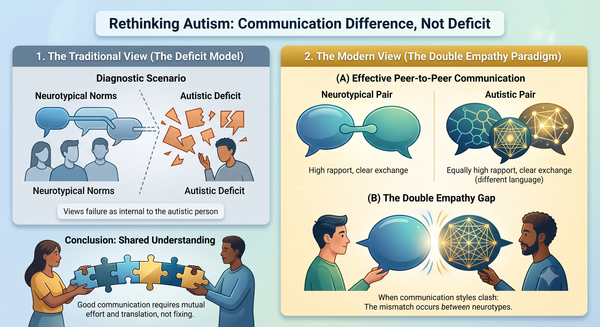
For neurodivergent individuals — particularly those with ADHD or Autism, who often experience heightened sensory and emotional processing — this misunderstanding runs even deeper. What gets labeled as “too emotional,” “too reactive,” or “hard to be around” is frequently a nervous system doing exactly what it was built to do, in an environment that wasn’t built for it.
What This Actually Means
If you cry easily, that’s not something to fix.
It means your brain integrates emotional and cognitive information quickly. It means you’re likely reading situations with more depth than the people around you realize. It means you probably notice what’s real in a room before anyone puts it into words.
The world spent a long time telling sensitive people they were too much. It turns out they were processing more than everyone else — and doing it faster.
That’s not a liability. That’s a different kind of intelligence. And it deserves to be understood, not managed away.
If this resonated with you, share it with someone who was told they were “too sensitive.” Sometimes the right reframe changes everything.
Sources & Further Reading
- LeDoux, J. (1996). The Emotional Brain. Simon & Schuster.
- Aron, E. (1997). Sensory Processing Sensitivity and its relation to introversion and emotionality. Journal of Personality and Social Psychology.
- Acevedo, B. et al. (2014). The highly sensitive brain: an fMRI study of sensory processing sensitivity. Brain and Behavior.
- Gračanin, A. et al. (2014). Is crying a self-soothing behavior? Frontiers in Psychology.
- Granneman, J. & Solo, A. (2023). Sensitive: The Hidden Power of the Highly Sensitive Person. Harmony Books.
- Vingerhoets, A. (2013). Why Only Humans Weep. Oxford University Press.