Autism Through a Divergent Lens
Reimagining Neurodiversity as Human Brilliance
A Paradigm Shift in Understanding
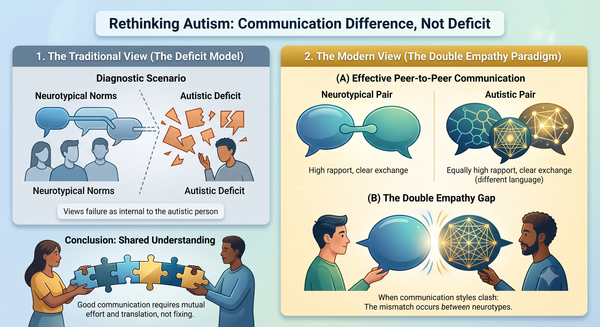
For generations, autism has been framed through a deficit-based lens, measured against a narrow standard of “typical” development and treated as a collection of symptoms requiring intervention. But what if this entire framework misses the point? What if autism represents not a deviation from the norm, but rather a profound expression of human diversity, one that holds unique gifts, perspectives, and ways of being that enrich our collective human experience?
It’s time we fundamentally evolve how we understand and embrace autism.

Beyond Pathology: Autism as Adaptive Intelligence
The medical model has long positioned autism as something broken, a neurological “disorder” to be fixed, managed, or contained. Yet emerging perspectives in neurodiversity research, positive psychology, and disability justice invite us to ask different questions: What if autistic minds aren’t malfunctioning, but rather functioning differently? What if these differences represent sophisticated adaptive strategies rather than deficits?
Autistic individuals often demonstrate remarkable capabilities that reflect deep intelligence:
Heightened Sensory Processing: What’s often labeled as “sensory sensitivity” can also be understood as extraordinary perceptual awareness. Many autistic people experience the world with vivid intensity, noticing subtleties in sound, light, texture, and pattern that others might miss entirely. This isn’t merely “oversensitivity”; it’s a different way of gathering and processing environmental information that can lead to profound insights and creative breakthroughs.
Pattern Recognition and Systemizing: Autistic minds frequently excel at detecting patterns, understanding complex systems, and thinking in detailed, logical ways. This cognitive style has driven innovation across fields, from mathematics and engineering to music and art. The ability to see connections others overlook represents a form of brilliance that has shaped human progress.
Deep Focus and Specialized Interests: The capacity for sustained, intense concentration on topics of passion isn’t a “restricted interest.” It’s the foundation of expertise. Many autistic individuals develop extraordinary depth of knowledge in their areas of interest, contributing specialized understanding that advances entire fields of study.
Authentic Expression: Many autistic people value directness, honesty, and consistency in ways that challenge social conventions built around politeness over truth. This commitment to authenticity offers a refreshing counterpoint to performative social norms and can foster more genuine human connections.
Reframing “Symptoms” as Survival Strategies
When we shift our perspective from pathology to adaptation, behaviors traditionally viewed as “symptoms” reveal themselves as intelligent responses to environmental and neurological realities:
Social Withdrawal as Energy Conservation: What’s often interpreted as “social deficit” or “isolation” can actually represent sophisticated self-regulation. Social interaction, particularly navigating unwritten rules, managing sensory input, and processing multiple communication channels simultaneously, can be genuinely exhausting for autistic individuals. Choosing solitude or limiting social exposure isn’t failure to connect; it’s wisdom about personal capacity and the preservation of emotional and physical resources.
Just as some people restore themselves through quiet reflection while others recharge through social connection, autistic individuals often require time alone to process experiences, decompress from sensory overload, and maintain wellbeing. This is self-care, not dysfunction.
Stimming as Self-Regulation: Repetitive movements like rocking, hand-flapping, or fidgeting aren’t meaningless behaviors to be suppressed. They’re self-soothing techniques that help regulate sensory input, manage anxiety, and maintain focus. These movements serve the same purpose as someone else might achieve through deep breathing or going for a run. They’re tools for emotional and neurological balance.
Routine and Predictability as Anchors: The preference for structure and routine reflects a need to conserve cognitive energy in an unpredictable world. When you process more sensory and social information than most people, having reliable patterns creates mental space for creativity, learning, and connection.
The Divergent Framework: Strength in Difference
If we borrow the metaphor from the Divergent series, we might say that autism represents individuals who don’t fit neatly into one prescribed “faction” of human functioning. Rather than being “factionless” or deficient, autistic people embody a different configuration of human strengths, one that challenges rigid categorization and reveals the limitations of systems designed for uniformity.
This divergent way of being offers society tremendous value:
- Innovation through Different Thinking: History’s greatest breakthroughs often came from minds that perceived problems differently. Autistic perspectives can illuminate solutions others might never consider.
- Depth Over Breadth: In a culture obsessed with superficial multitasking, autistic focus models the power of deep engagement and specialized mastery.
- Honesty and Integrity: Direct communication and consistent values create foundations for trust and genuine relationship.
- Sensory Richness: Enhanced perception invites us all to experience the world more fully, to notice beauty, detail, and complexity we might otherwise overlook.
Building Affirming Environments
If autism is divergence rather than disorder, our responsibility shifts from “fixing” autistic individuals to creating environments where diverse minds can flourish:
In Education: Moving beyond one-size-fits-all teaching toward flexible, strength-based approaches that honor different learning styles, provide sensory accommodations, and value diverse forms of intelligence and expression.
In Workplaces: Recognizing that productivity looks different for different people. Offering flexible schedules, quiet workspaces, clear communication, and opportunities for deep work allows autistic employees to contribute their considerable talents.
In Communities: Creating spaces that celebrate neurodiversity, where stimming is normalized, where different communication styles are respected, where silence and solitude are honored alongside social connection.
In Relationships: Embracing that intimacy and care can be expressed and received in many ways. Moving beyond neurotypical scripts for connection opens possibilities for more authentic relating.
Resources for Further Exploration
Books
- “NeuroTribes: The Legacy of Autism and the Future of Neurodiversity” by Steve Silberman. A comprehensive history that reframes autism as natural human variation
- “Unmasking Autism: Discovering the New Faces of Neurodiversity” by Devon Price. Explores autistic identity and the harm of forced conformity
- “Uniquely Human: A Different Way of Seeing Autism” by Barry M. Prizant. A compassionate, strength-based approach from a clinical perspective
- “Loud Hands: Autistic People, Speaking” edited by Julia Bascom. Essays by autistic self-advocates centering autistic voices
Organizations and Websites
- Autistic Self Advocacy Network (ASAN) (autisticadvocacy.org). “Nothing About Us Without Us,” led by and for autistic people
- Neurodiversity Hub. Resources celebrating neurological differences as natural variations
- Thinking Person’s Guide to Autism. Evidence-based information centered on acceptance and support
- Therapist Neurodiversity Collective. Mental health resources from a neurodiversity-affirming perspective
Online Communities
- #ActuallyAutistic. Social media hashtag for autistic voices and experiences
- r/autism and r/AutisticPride. Reddit communities for connection and support
- Autistic Not Weird. Community and resources celebrating autistic identity
Academic and Research
- Neurodiversity Paradigm resources. Exploring autism through the lens of human diversity rather than pathology
- Participatory autism research. Studies conducted with rather than on autistic communities
The Invitation
Autism isn’t something to solve, cure, or overcome. It’s an invitation to expand our understanding of what it means to be human, to recognize that there are many valid ways to think, feel, communicate, and move through the world.
When we stop trying to force square pegs into round holes and instead honor the unique shape of each person, we discover that humanity’s greatest strength has always been our diversity. The ways our minds defy easy categorization, challenge limiting systems, and rewrite restrictive rules aren’t problems. They’re precisely what drives human evolution forward.
Autistic individuals aren’t asking for pity or fixing. They’re asking for understanding, accommodation, and the freedom to exist authentically in a world that too often demands conformity.
A Closing Reflection
Perhaps the real “disorder” isn’t autism at all. It’s a society so attached to narrow definitions of normal that it struggles to recognize brilliance in unfamiliar forms.
When we embrace autism as divergence, as a vital, valuable thread in the rich tapestry of human experience, we don’t just affirm autistic people. We expand possibilities for everyone. We create room for all of us to be more fully ourselves.
Autism isn’t a disorder. It’s divergence.
And divergence, throughout history, has always been the birthplace of transformation.
This article centers neurodiversity-affirming perspectives and draws on insights from autistic self-advocates, positive psychology, and social justice frameworks. For support navigating autism—whether as an autistic individual, family member, or ally—consider connecting with autistic-led organizations and neurodiversity-affirming professionals who honor the full humanity and inherent worth of autistic people.