Beyond Disorder: Autism and ADHD as Ways of Being in the World

Share
Beyond Disorder: Autism and ADHD as Ways of Being in the World

The conversation around autism and ADHD is shifting, and it’s about time. For too long, we’ve approached these neurotypes through a lens of deficit and dysfunction. We’ve asked “What’s wrong?” when we should have been asking “What does this person need?” We’ve tried to fix what was never broken, to cure what doesn’t need curing.

Here’s what I want you to understand: Autism and ADHD aren’t disorders. They’re different operating systems running on human hardware. And the real disability? That comes from living in a world designed exclusively for one type of brain.

The Problem with “Disorder”

When we label something a disorder, we’re making a statement about where the problem lives. The medical model tells us the problem is inside the person—in their brain, their biology, their essential being. This framework has dominated how we think about neurodivergence since Leo Kanner first described autism in the 1940s.

But this way of thinking misses something crucial. Recent research from the neurodiversity movement challenges this entire premise. A 2024 study published in Autism Research found that when we focus solely on internal “deficits,” we ignore how much disability comes from the mismatch between a person and their environment.

Think about it this way: Is someone who needs glasses “disordered”? Or do they simply need an accommodation to interact with a world designed around 20/20 vision? The latter feels more accurate, more humane. So why do we treat neurological differences any differently?

The social model of disability offers us a better framework. This model, which emerged from disability rights activism in the 1960s and 70s, distinguishes between impairment (functional differences in how we move, sense, or think) and disability (the barriers we face when our environment doesn’t account for those differences).

When we apply this lens to autism and ADHD, something powerful happens. We stop asking “How do we make this autistic child sit still and make eye contact?” and start asking “How do we create spaces where different communication styles are valued?” We stop trying to eliminate ADHD traits and start building systems that work with the ADHD mind, not against it.

The Double Empathy Problem: Difference Isn’t Deficit

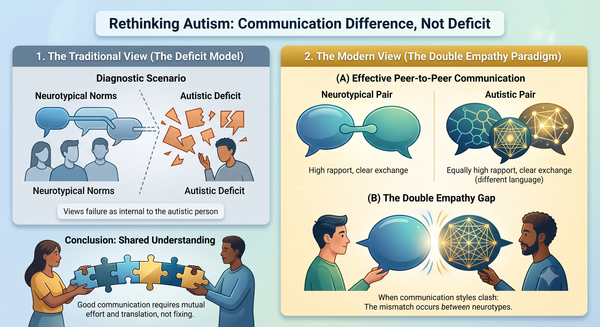
One of the most groundbreaking shifts in how we understand autistic communication comes from Dr. Damian Milton’s theory of the double empathy problem. Milton, himself autistic, noticed something that had been hiding in plain sight: communication difficulties between autistic and non-autistic people aren’t one-sided.

Here’s what the traditional view got wrong. For decades, researchers claimed autistic people lacked empathy or had deficits in “theory of mind”—the ability to understand others’ mental states. But Milton’s research tells a different story. When autistic people communicate with other autistic people, they report high levels of rapport and understanding. Similarly, non-autistic people communicate easily with other non-autistic people.

The breakdown happens at the intersection. Both groups struggle to understand each other, but we’ve placed all the burden of accommodation on autistic individuals. As one recent article from Autism.org.uk explains, “autistic empathy is no less compassionate, no less thoughtful, no less ‘human’ than non-autistic empathy: it is simply different.”

This isn’t about one group being better or worse at communication. It’s about different communication styles, shaped by different sensory experiences, different social priorities, different ways of processing the world. The problem is mutual—it’s double—but the consequences have never been equal.

Non-autistic people don’t face intensive behavioral therapy to learn autistic communication styles. They’re not taught that their way of being is wrong. Instead, autistic people are expected to mask, to perform neurotypicality, often at tremendous cost to their mental health and wellbeing.

A 2022 follow-up to Milton’s original work emphasizes that “an account of the double empathy problem cannot ignore” power relations. When one group holds cultural dominance, their way of communicating becomes “normal” and everyone else’s becomes deficit.

What Neurodiversity Actually Means

The term neurodiversity simply describes a fact: human brains are diverse. Just as we have biodiversity in nature, we have neurodiversity in human cognition. Some brains are autistic, some have ADHD, some are dyslexic, some are none of these things. This diversity isn’t good or bad—it just is.

But the neurodiversity paradigm goes further. It asks us to value this diversity, to see it as part of what makes humanity rich and varied. As Dr. Nick Walker writes in their influential essay “Throw Away the Master’s Tools,” embracing the neurodiversity paradigm means fundamentally shifting how we think about human minds.

Walker, a queer autistic scholar whose work has shaped modern neurodiversity discourse, argues that neurotypicality isn’t actually a neutral baseline. Instead, it’s a socially constructed performance that gets enforced through the same mechanisms as gender normativity. Their concept of “neuroqueering”—actively resisting the pressure to perform neurotypicality—offers a framework for understanding why masking is so exhausting and why authenticity matters so much.

The Autistic Self Advocacy Network (ASAN), a leading organization run by and for autistic people, puts it plainly: “Neurodiversity means that no two brains are exactly the same. Every person has things they are good at and things they need help with, and there is no such thing as a ‘normal’ brain.”

This perspective has gained significant traction. A comprehensive 2024 study of 504 autistic and autism community members found that neurodiversity movement supporters primarily advocated for societal reform and creating more supportive environments, rather than trying to normalize autistic behavior. Importantly, they remained open to individualized supports—just not ones aimed at making autistic people “less autistic.”

ADHD: Beyond the Attention “Deficit”

ADHD might be one of the most misunderstood neurotypes out there. The name itself—Attention Deficit Hyperactivity Disorder—frames everything in terms of what’s supposedly lacking or excessive. But people with ADHD don’t have a deficit of attention. They have a different attention system.

The ADHD brain is interest-driven. When something captures our attention, we can hyperfocus for hours, achieving states of deep flow that neurotypical people often struggle to reach. When something doesn’t engage us, directing attention feels like pushing water uphill. This isn’t a character flaw or a lack of willpower. It’s how our brains work.

Research on ADHD and rejection sensitivity, particularly work by Dr. William Dodson, has revealed how deeply emotional processing differs in ADHD. Many people with ADHD experience rejection-sensitive dysphoria (RSD)—an intense emotional response to perceived rejection or criticism. Dodson notes that his patients only opened up about these experiences after he established trust and made clear he didn’t see them as flawed.

The challenges of ADHD are real. Executive dysfunction can make everyday tasks feel overwhelming. Time blindness can create genuine problems with scheduling and deadlines. But these challenges often become disabilities because of how our world is structured.

Traditional classrooms demand sustained attention to topics someone else chose, following a rigid schedule, sitting still for hours. Traditional workplaces often value busywork over productivity, demand arbitrary schedules over results, and penalize unconventional approaches. These environments don’t just fail to support ADHD brains—they actively work against them.

But here’s what happens when we create ADHD-friendly environments: When we allow movement during learning, attention improves. When we design project-based work around areas of interest, hyperfocus becomes an asset. When we judge people by their output rather than how they achieve it, ADHD creativity and innovation shine.

Autism: Rethinking “Social Deficits”

The diagnostic criteria for autism center heavily on “social communication deficits.” But let’s unpack what that really means. Who decided what counts as “normal” social communication? Who gets to define what’s a deficit?

Autistic communication is direct, honest, information-focused. Many autistic people struggle with small talk but excel at deep, focused conversations about topics of shared interest. They might not make eye contact, but they’re often intensely present and listening. They might not use typical facial expressions, but their emotions are genuine and deep.

The problem isn’t that autistic communication is deficient. The problem is that neurotypical people often misinterpret or devalue autistic communication styles.

Recent research on autistic interaction has found that when autistic people interact with each other, their communication can be highly effective. Studies by Dr. Catherine Crompton and others found that autistic individuals in pairs reported high levels of rapport with each other, while mixed neurotype pairs experienced communication breakdowns—breakdowns that non-autistic observers typically blamed on the autistic person.

This brings us back to the double empathy problem. Non-autistic people struggle to “read” autistic people just as much as the reverse. But only autistic people are told they need intensive therapy to learn better social skills. Only autistic people are expected to change.

Many autistic people describe masking—performing neurotypical behavior—as exhausting, traumatic, and disconnecting. Dr. Devon Price’s research in “Unmasking Autism” reveals that masked autistic individuals often struggle for decades before discovering their true selves. The mental health costs are substantial: higher rates of anxiety, depression, burnout, and even shortened life expectancy.

When we create environments that welcome autistic ways of being, something shifts. We see autistic people thrive. We recognize their strengths: pattern recognition, attention to detail, direct communication, strong sense of justice, passionate pursuit of interests, loyalty in relationships.

Where Disability Actually Lives

So if autism and ADHD aren’t inherently disabling, where does disability come from? The answer is both simple and complex: disability emerges at the intersection of neurological difference and environmental mismatch.

Consider sensory processing. Many autistic people have heightened or different sensory experiences. Fluorescent lights might cause physical pain. Certain textures might be unbearable. Background noise might make focusing impossible. These aren’t symptoms of a disorder—they’re differences in how the nervous system processes input.

The disability occurs when we design every office with fluorescent lights, every school with echoing hallways, every public space with overwhelming sensory input. We could design differently. We could have quiet spaces, adjustable lighting, consideration for sensory needs. The fact that we don’t is a choice, not a necessity.

Or consider executive function challenges common in both autism and ADHD. Planning, organizing, initiating tasks, managing time—these can be genuinely difficult. But how much of that difficulty is inherent, and how much comes from systems that offer zero support?

What if we normalized having systems and supports? What if we built in visual schedules, body doubling, external structure? What if we stopped treating these accommodations as “special” and started seeing them as universal design?

A 2025 paper on neurodiversity and the UN Sustainable Development Goals emphasizes that the neurodiversity concept “challenges the traditional medical model of disability and promotes the social model, emphasizing inclusion and acceptance of individuals with conditions such as autism, ADHD, dyslexia, and other neurodevelopmental differences.”

The Violence of Normalization

We need to talk about what happens when we treat neurodivergence as something to fix. Applied Behavior Analysis (ABA), still considered the “gold standard” for autism intervention, was developed using the same techniques used to “convert” gay people. Its goal is compliance, conformity, appearing “indistinguishable from peers.”

Autistic adults who went through intensive ABA as children often describe it as traumatic. They learned to suppress their natural responses, to perform normalcy, to hide who they are. They learned that their authentic selves were unacceptable.

This isn’t an artifact of old, outdated practices. The fundamental problem persists: when intervention focuses on making someone appear more neurotypical rather than supporting their actual needs, we’re prioritizing the comfort of non-disabled people over the wellbeing of neurodivergent people.

ASAN and other neurodiversity organizations don’t oppose all intervention. They oppose interventions aimed at normalization. They support interventions that increase autonomy, communication access, skill-building that the person themselves wants, and accommodations that reduce suffering.

There’s a crucial difference between helping someone develop skills they desire and forcing them to perform neurotypicality against their will. One respects autonomy. The other denies it.

Building Neuroaffirming Spaces

So what does it look like to actually embrace neurodiversity? How do we create spaces where different brains can thrive?

It starts with shifting our questions. Instead of “How do we make this person fit our space?” we ask “How do we adapt our space to include this person?” Instead of “How do we reduce these behaviors?” we ask “What is this person communicating? What do they need?”

Neuroaffirming practice centers the experience and autonomy of neurodivergent people. It recognizes stimming as self-regulation, not problem behavior. It values different forms of communication, including AAC, typing, and non-speaking communication. It understands that eye contact isn’t respect, sitting still isn’t learning, and compliance isn’t success.

In education, neuroaffirming approaches mean offering choice in how students demonstrate knowledge, creating sensory-friendly environments, teaching neurotypical students about autism and ADHD, and valuing neurodivergent students as they are.

In employment, it means flexible schedules, remote work options, clear communication about expectations, quiet workspaces, and judging people by their contributions rather than their performance of neurotypicality.

In healthcare, it means listening to neurodivergent people about their own experiences, not dismissing their reports, adjusting communication styles, and recognizing that trauma-informed care is essential for people who’ve spent their lives being told they’re wrong.

In relationships, it means accepting different communication and affection styles, respecting boundaries around sensory input and social energy, and recognizing that intimacy takes many forms.

The Importance of Autistic Leadership

One of the core principles of disability rights is “Nothing About Us Without Us.” When it comes to autism and ADHD, this means centering the voices, experiences, and leadership of autistic and ADHD people themselves.

For too long, autism research and advocacy were dominated by non-autistic people. Parents, clinicians, researchers—all making decisions about autistic lives without meaningfully including autistic perspectives. The results were often harmful: interventions focused on making autistic people look normal rather than supporting their wellbeing, research that treated autism as a tragedy rather than a difference, advocacy that spoke over rather than with autistic people.

The shift toward autistic-led organizations like ASAN represents a fundamental change. When autistic people lead autism advocacy, the priorities shift. The focus moves to quality of life, autonomy, inclusion, and acceptance. Research becomes more relevant to autistic people’s actual needs.

The same applies to ADHD advocacy. When ADHD people share their experiences and strategies, we get real, practical wisdom about what actually helps. We move beyond behavioral checklists to understand the lived experience of an ADHD brain.

This doesn’t mean non-autistic allies or parents don’t have a role. They absolutely do. But that role should be supportive, listening, amplifying autistic voices, not speaking over them.

Intersectionality Matters

We can’t talk about neurodiversity without acknowledging how it intersects with other identities. Autistic people of color, particularly Black autistic people, face higher rates of misdiagnosis, underdiagnosis, and criminalization. Their autism is more likely to be seen as behavioral problems than as a neurological difference requiring support.

Autistic women and nonbinary people were left out of early autism research entirely, leading to diagnostic criteria that still primarily reflect how autism presents in white boys. This means many women and nonbinary people go undiagnosed or are misdiagnosed with personality disorders or mental health conditions.

LGBTQ+ neurodivergent people face unique challenges. Research consistently shows that autistic and ADHD people are more likely to be LGBTQ+ than the general population. Dr. Nick Walker’s work on neuroqueering helps explain why: both neuronormativity and heteronormativity are socially enforced performances, and people who struggle with one often question the other.

Economic class matters too. Diagnosis and support often require resources many families don’t have. The conversation about neurodiversity has to include advocacy for accessible healthcare, education, and services.

Moving Forward: A Call to Action

Shifting from the pathology paradigm to the neurodiversity paradigm isn’t just an academic exercise. It has real, material consequences for how neurodivergent people are treated, what resources they can access, how they understand themselves.

Here’s what this shift looks like in practice:

In Policy: We need disability rights legislation that actually protects neurodivergent people from discrimination. We need education funding that supports inclusive classrooms. We need employment protections that go beyond bare minimum accommodations.

In Practice: Teachers, therapists, doctors, employers—all need training from neurodivergent people about what neuroaffirming practice looks like. We need to move beyond compliance-based models to approaches that center autonomy and wellbeing.

In Culture: We need more neurodivergent representation in media, in leadership, in public life. Not inspiration porn or tragic stories, but realistic portrayals that show the full humanity of neurodivergent people.

In Research: We need research driven by questions that matter to neurodivergent people, conducted with meaningful inclusion of neurodivergent researchers and participants, focused on improving quality of life rather than eliminating difference.

In Community: We need to build communities where different minds are not just tolerated but valued. Where accommodation isn’t seen as special treatment but as basic access. Where people can unmask, stim, use AAC, need breaks, and still belong.

The World Needs Neurodiversity

Here’s something the pathology paradigm misses entirely: neurodivergent people aren’t just valuable despite their differences. Many of the traits associated with autism and ADHD have tremendous value.

Autistic people’s pattern recognition has led to breakthroughs in science and technology. Their attention to detail catches errors others miss. Their passionate interest in specific topics creates deep expertise. Their direct communication cuts through social pleasantries to get to truth.

ADHD creativity and out-of-the-box thinking drive innovation. ADHD hyperfocus enables intensive, productive work. ADHD urgency can mobilize action when action is needed.

Many important cultural and scientific advances have come from neurodivergent minds. We don’t know exactly who was neurodivergent in history, but we can recognize traits. The scientists who revolutionized their fields through obsessive focus. The artists who saw the world differently. The activists who couldn’t accept injustice.

Neurodiversity isn’t just about accommodating difference. It’s about recognizing that human cognitive diversity makes us collectively stronger, more creative, more capable of solving complex problems.

Conclusion: Rewriting the Story

The story we tell about autism and ADHD matters. When we tell a story of disorder, deficit, and dysfunction, we create a world that tries to eliminate neurodivergent people or force us into neurotypical molds. When we tell a story of difference, diversity, and divergence, we create a world with room for all kinds of minds.

I’m not saying autism and ADHD are all sunshine and superpowers. Real challenges exist. Some autistic people need substantial support. Some ADHD people struggle deeply. Disability is real.

But disability isn’t the same as defect. Support needs don’t equal less-than. And the biggest barriers neurodivergent people face aren’t our brains—they’re the social structures that exclude us, the attitudes that devalue us, the systems that weren’t built for us.

We can build different systems. We can adopt different attitudes. We can create a world where autistic and ADHD people don’t have to choose between authenticity and acceptance, where we can be ourselves and still belong.

That world starts with language, with how we think and talk about neurodivergence. It continues with action—policy changes, practice changes, cultural changes. And it requires all of us—neurodivergent and neurotypical alike—to question what we’ve been taught about “normal” and “disordered.”

The neurodiversity paradigm isn’t about denying that autism and ADHD are disabilities. It’s about understanding where disability comes from, what causes it, and what we can change. It’s about building a world where different minds don’t just survive—they thrive.


Resources and Organizations

Autistic Self Advocacy Network (ASAN)
https://autisticadvocacy.org/

The leading organization run by and for autistic people, focused on disability rights, inclusion, and autistic-led advocacy.

Autism.org.uk
https://www.autism.org.uk/

UK-based organization with comprehensive resources on neurodiversity, the social model, and the double empathy problem.

Reframing Autism
https://reframingautism.org.au/

Australian organization providing research, resources, and community from a neurodiversity-affirming perspective.

Nick Walker’s Neuroqueer
https://neuroqueer.com/

Essays and resources from Dr. Nick Walker on the neurodiversity paradigm, including the influential “Throw Away the Master’s Tools.”

Gliszen Therapeutic
https://gliszentherapeutic.com/

Neuroaffirming therapy and consulting services, with resources on autism, ADHD, and creating inclusive environments.

NeuroaffirmativityPractical strategies and authentic stories from neurodivergent perspectives, making space for everyone's unique way of being. We explore, test new approaches, build compassion, and discover our strengths.By Rachelle P. Goldenberg, LCSW


Further Reading

Books:

  • Neuroqueer Heresies by Nick Walker
  • Unmasking Autism by Devon Price
  • Loud Hands: Autistic People, Speaking (anthology edited by Julia Bascom)

Key Research:

  • Milton, D.E.M. (2012). “On the ontological status of autism: The ‘double empathy problem.’”
  • Dwyer, P. et al. (2024). “Community views of neurodiversity, models of disability and autism intervention.”
  • Chapman, R. (2020). “The reality of autism: On the metaphysics of disorder and diversity.”

Articles and Essays:

  • “Throw Away the Master’s Tools: Liberating Ourselves from the Pathology Paradigm” by Nick Walker
  • “The Double Empathy Problem: Ten Years On” by Damian Milton
  • “Nothing About Us Without Us: The Importance of Autistic-Led Advocacy”