The DSM Just Validated What Neuroaffirming Therapists Have Known All Along
The DSM Is Getting an Intersectional Upgrade—Finally
Something significant just happened in the world of psychiatric diagnosis, and it’s worth talking about.
The American Psychiatric Association released their strategic vision for the future of the DSM at the end of January 2025. Five papers published in the American Journal of Psychiatry lay out a roadmap that acknowledges what many of us have been saying: you can’t understand someone’s mental health—or their neurodivergence—without understanding their entire life context.
What’s Actually Changing
The Strategic Committee is proposing to rename the manual from the Diagnostic and Statistical Manual to the Diagnostic and Scientific Manual. One of their four focus areas is about socioeconomic, cultural, and environmental determinants of health (SCE-DoH). These factors would be systematically integrated into assessment and treatment planning—not as a checkbox, but as core diagnostic context.
Why This Matters for Neurodivergent Professionals
For those of us who got diagnosed late, or who’ve spent decades masking to survive in professional environments, this speaks to something we already know: the current diagnostic framework wasn’t built for us.
The criteria were written based on observations of white, middle-class, cisgender boys. If you’re a woman who learned to force eye contact in meetings, a person of color who’s code-switched your entire life, or queer/trans and masking became survival—the diagnostic criteria miss you.
A lot of autistic and ADHD adults didn’t get diagnosed until their 30s, 40s, or later. Not because they weren’t neurodivergent as children, but because they didn’t fit the stereotype. Their sensory overwhelm got written off as anxiety. Their need for routine got called rigid. Their executive function struggles got labeled as laziness.
The disparities are sharper for people navigating multiple marginalized identities. Black and Latino children with ADHD are way less likely to be diagnosed compared to white children with identical symptoms. When diagnosed, they’re less likely to receive treatment. Asian-American children have the lowest treatment rates. For autism, children of color are diagnosed later—often years later—and usually only when symptoms are more severe.
The Workplace Impact
These diagnostic gaps follow us into our careers. How many performance reviews have framed our autistic communication style as “not a team player” or our ADHD need for novelty as “lacks focus”? How many of us have been told we’re “too sensitive” when experiencing sensory overload?
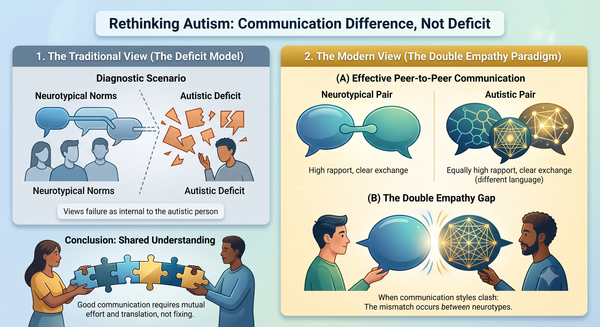
The current model asks “what’s wrong with this person?” instead of “what does this person need to thrive here?” It ignores how chronic stress from discrimination, economic instability, or cultural mismatch changes how neurodivergence presents.
Intersectionality Matters
The committee’s emphasis on intersectionality is significant. Neurodivergence doesn’t exist separate from your other identities.
If you’re autistic and transgender, you’re navigating a world that pathologizes both your gender and your neurology. The masking strategies overlap. The exhaustion compounds.
If you’re ADHD and living with economic precarity, your executive function challenges interact with systemic barriers. You can’t just “use a planner” when you’re working three jobs.
If you’re navigating racism while neurodivergent, there’s a specific hypervigilance involved. You’re already code-switching, already managing the cognitive load of existing in predominantly white spaces. Add masking on top? The burnout is real.
Creating Space for Neuroaffirmative Practice
If the DSM integrates socioeconomic and cultural context, it creates space for more neuroaffirmative frameworks. When you acknowledge that “impairment” is often about environmental mismatch rather than individual pathology, you start asking different questions.
A lot of what gets medicalized as autism or ADHD “dysfunction” is the collision between a neurodivergent nervous system and environments designed exclusively for neurotypical people. The sensory overwhelm isn’t a deficit—it’s a response to fluorescent lights and constant noise. The executive function struggles aren’t laziness—they’re what happens when you’re expected to track seventeen projects at once with no external structure.
Validating Neuroaffirming Therapists
This has big implications for clinicians who’ve been doing neuroaffirming work—often while swimming upstream against their own training.
Neuroaffirmative therapists have been reframing “symptoms” as responses to context for years. They’ve been treating autistic burnout as real even though it’s not in the DSM. They’ve been centering clients’ lived experiences over checklist criteria. They’ve been asking about masking, discrimination, and systemic barriers as essential diagnostic information—not optional background details.
And they’ve often done this without institutional support. Sometimes facing pushback from colleagues who see neurodiversity-affirming approaches as “not evidence-based.” Sometimes struggling to get insurance reimbursement because their approaches don’t fit pathology-based billing codes.
If the DSM officially recognizes that you need to understand someone’s full context to understand their neurodivergence, it validates years of clinical innovation that happened at the margins. The therapist who asks about your experiences with racial discrimination as part of an ADHD evaluation isn’t going rogue—they’re providing competent, contextual assessment.
This could shift what “good practice” looks like. It could legitimize conversations about systemic oppression as clinically relevant. It could support therapists who center client self-determination and cultural identity. And it could help address the shortage of truly neuroaffirming providers by changing what gets taught in graduate programs and what counts as competent practice.
The Risks
This could go sideways. If clinicians aren’t properly trained, adding more assessment factors could just mean more opportunities for bias. If the focus on socioeconomic determinants becomes “poor people are higher risk for pathology” without addressing systemic oppression, we’ve just medicalized inequality.
There’s also concern about the biomarkers piece. The committee is exploring genetics, brain imaging, and biological markers. That could reinforce the idea that neurodivergence is a medical problem needing a cure, potentially leading to prenatal testing for autism.
And institutional adoption is slow. The DSM can say whatever it wants about cultural context—if insurance companies don’t reimburse for the additional assessment time that requires, nothing changes.
What This Could Mean
The committee wants the DSM to become a “living document” that updates more frequently. That’s needed for keeping pace with what we’re learning about how neurodivergence presents across different genders, cultures, ages, and contexts.
Will this change your next evaluation immediately? Probably not. These are proposals, not policy. Implementation takes years.
But something is shifting. The idea that diagnostic criteria should reflect diverse presentations. That context isn’t optional. That late-diagnosed adults weren’t “less autistic” or “less ADHD”—they were just invisible to a system built on a narrow template.
For neuroaffirming therapists, this could mean their clinical judgment gets backed by the official diagnostic manual instead of contradicting it. For neurodivergent professionals, this could mean evaluations that actually see you.
You weren’t missing from the research because you weren’t neurodivergent. You were missing because the research didn’t know how to see you.
Maybe that’s starting to change.
References
American Psychiatric Association. (2025). APA releases roadmap for the future of the DSM. Psychiatry.org. https://www.psychiatry.org/News-room/News-Releases/APA-Releases-Roadmap-for-Future-of-DSM
Coker, T. R., Elliott, M. N., Toomey, S. L., Schwebel, D. C., Cuccaro, P., Tortolero Emery, S., Schuster, M. A. (2016). Racial and ethnic disparities in ADHD diagnosis and treatment. Pediatrics, 138(3), e20160407. https://pmc.ncbi.nlm.nih.gov/articles/PMC5684883/
Mandell, D. S., Wiggins, L. D., Carpenter, L. A., Daniels, J., DiGuiseppi, C., Durkin, M. S., Giarelli, E., Morrier, M. J., Nicholas, J. S., Pinto-Martin, J. A., Shattuck, P. T., Thomas, K. C., Yeargin-Allsopp, M., & Kirby, R. S. (2009). Racial/ethnic disparities in the identification of children with autism spectrum disorders. American Journal of Public Health, 99(3), 493-498. https://pmc.ncbi.nlm.nih.gov/articles/PMC8500365/
Morgan, P. L., Staff, J., Hillemeier, M. M., Farkas, G., & Maczuga, S. (2013). Racial and ethnic disparities in ADHD diagnosis from kindergarten to eighth grade. Pediatrics, 132(1), 85-93. https://pmc.ncbi.nlm.nih.gov/articles/PMC3691530/
Oquendo, M. A. (2025). What’s next for the DSM? Psychiatric News. https://psychiatryonline.org/doi/10.1176/appi.pn.2025.12.12.17
Shi, Y., Hunter Guevara, L. R., Dykhoff, H. J., Sangaralingham, L. R., Phelan, S., Zaccariello, M. J., & Warner, D. O. (2021). Racial disparities in diagnosis of attention-deficit/hyperactivity disorder in a US national birth cohort. JAMA Network Open, 4(3), e210321. https://pmc.ncbi.nlm.nih.gov/articles/PMC7921900/
Uzoaru, C., et al. (2025). Addressing racial inequities: A systematic review of intervention programs for Black/African American children with autism spectrum disorder and attention-deficit hyperactivity disorder (2019–2024). Pediatric Medicine. https://pm.amegroups.org/article/view/8457/html
Zablotsky, B., & Alford, J. M. (2020). Racial and ethnic differences in the prevalence of attention-deficit/hyperactivity disorder and learning disabilities among U.S. children aged 3-17 years. NCHS Data Brief, No. 358. https://www.cdc.gov/nchs/products/databriefs/db358.htm