The Two Sides of AuDHD: What Everyone Sees and What They Miss

...a personal take.
Share
The Two Sides of AuDHD: What Everyone Sees and What They Miss

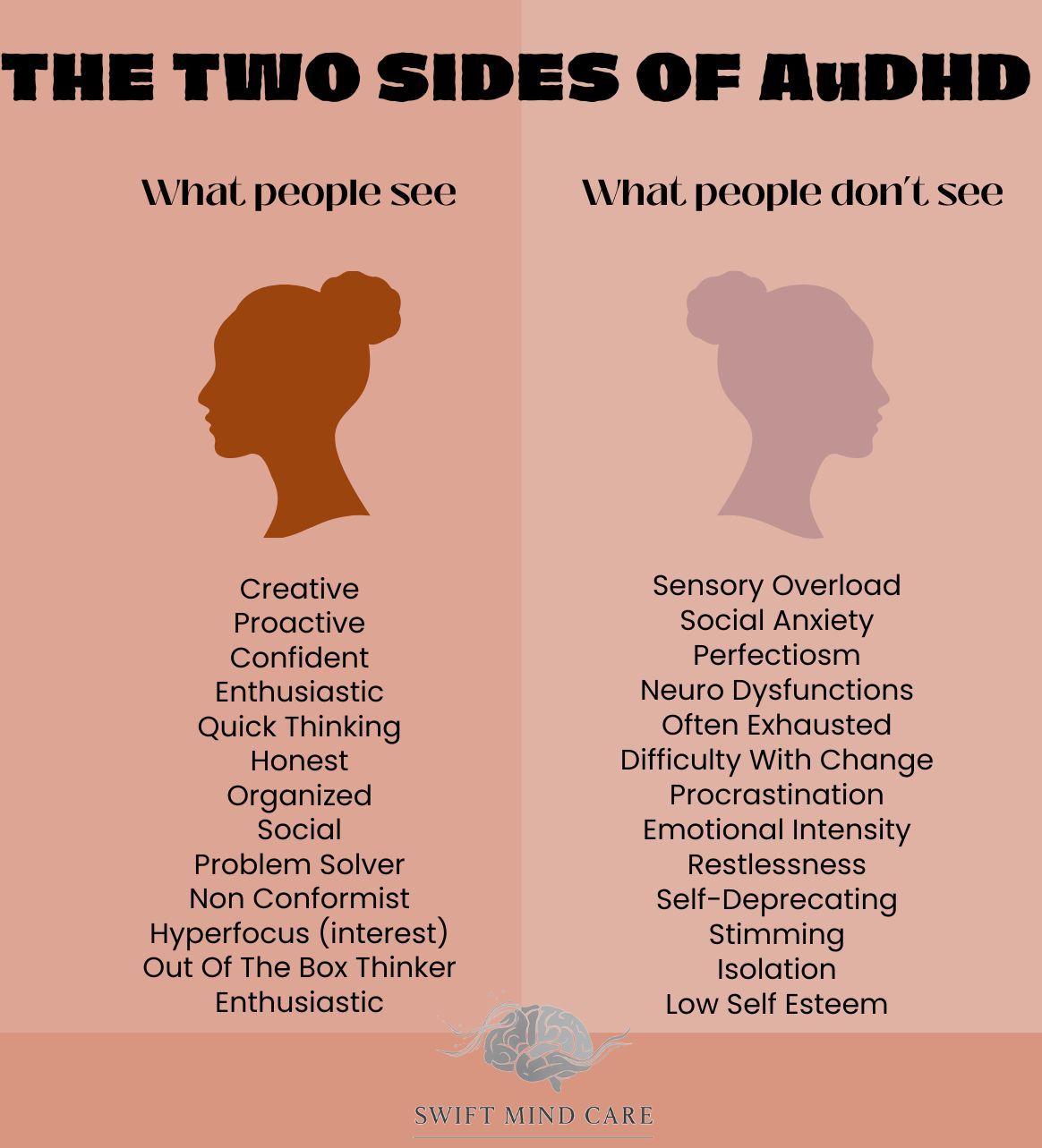
When people meet me, they usually notice the stuff on the left side of this graphic (yes it’s a little tweeked but you get the picture). The creativity, the enthusiasm, how I can hyperfocus on things that matter to me. Sometimes they even appreciate those qualities.

What they don’t see? Pretty much everything on the right.

AuDHD is what we call the co-occurrence of autism and ADHD. And if you have both, you know this image hits different. It’s not that one side is “good” and the other is “bad.” Both sides are real. Both sides are us. But we live in a world that only wants to acknowledge half the picture.

The Visible Strengths

(And Why They’re Not the Whole Story)

Yes, I can be creative and think outside the box. I can dive deep into special interests and come up with solutions other people miss. When I’m in my zone, I’m proactive, organized, even confident.

But here’s what people miss: those strengths come with a cost. That creativity? It’s often paired with sensory overload that leaves me unable to function in bright, loud spaces. The hyperfocus that makes me great at problem-solving? It’s the same brain wiring that makes transitions feel like emotional whiplash.

The world celebrates the “quirky genius” parts of neurodivergence while ignoring the fact that we’re often running on empty just to appear functional.

What Lives Behind the Mask

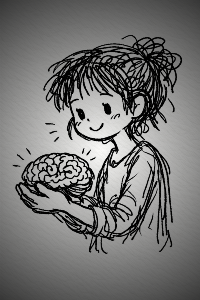
3 year old Chelle….little me.

Sensory overload isn’t just “being sensitive.” It’s your nervous system treating a fluorescent light like a physical assault. Social anxiety isn’t shyness. It’s the exhausting mental math of trying to decode unspoken rules while simultaneously managing your own dysregulation.

Perfectionism and procrastination aren’t character flaws. They’re trauma responses. When you’ve been corrected, redirected, and criticized your whole life for being “too much” or “not enough,” of course you’re going to freeze up or chase impossible standards.

And the exhaustion? That’s not laziness. That’s what happens when your brain is processing exponentially more information than a neurotypical brain, all day, every day, with no off switch.

The pelt-o-storms “peltostorms” (what some people call “brain fog” but feels more like your thoughts are being pelted from all directions), the difficulty with change, the emotional intensity, the stimming, the isolation, the low self-esteem that comes from a lifetime of being misunderstood... these aren’t separate from the strengths. They’re part of the same neurological package.

Why This Matters

When we only acknowledge the “marketable” parts of neurodivergence, we’re not actually accepting neurodivergent people. We’re just accepting the parts that are useful to others.

Real acceptance means understanding that the person who can write brilliant code for six hours straight might need three days to recover. It means knowing that someone’s honesty and directness isn’t rudeness, it’s genuinely how they communicate. It means recognizing that what looks like procrastination might actually be someone trying to regulate their nervous system enough to even start the task.

We need accommodations, not just appreciation. We need understanding, not just utilization.

Moving Forward

If you’re AuDHD, you already know both sides of this picture intimately. You’ve probably spent years trying to show people only the left side while managing the right side in private. That’s exhausting, and you deserve better.

If you’re not AuDHD but someone you love is, sit with the right side of this image. Really sit with it. Ask questions. Listen. Understand that support means acknowledging both sides, not just celebrating the convenient one.

Both sides are real. Both sides deserve to be seen. And honestly? We’re tired of being half-visible.


References and Resources for Further Research

Books:

  • NeuroTribes: The Legacy of Autism and the Future of Neurodiversity by Steve Silberman
  • Unmasking Autism: Discovering the New Faces of Neurodiversity by Devon Price
  • A Radical Guide for Women with ADHD by Sari Solden and Michelle Frank
  • Divergent Mind: Thriving in a World That Wasn’t Designed for You by Jenara Nerenberg
  • The Autistic Brain: Thinking Across the Spectrum by Temple Grandin and Richard Panek

Research Articles and Academic Resources:

  • Antshel, K. M., et al. (2013). “Is ADHD a valid disorder in children with intellectual delays?” Clinical Psychology Review
  • Rødgaard, E. M., et al. (2019). “Temporal Changes in Effect Sizes of Studies Comparing Individuals With and Without Autism” JAMA Psychiatry
  • Kentrou, V., et al. (2019). “Delayed Autism Spectrum Disorder Recognition in Children and Adolescents Previously Diagnosed with Attention-Deficit/Hyperactivity Disorder” Autism
  • Hours, C., et al. (2022). “ASD and ADHD Comorbidity: What Are We Talking About?” Frontiers in Psychiatry

Online Resources:

Note on Research: Much existing research has historically excluded women, BIPOC individuals, and those assigned female at birth from autism and ADHD studies. Newer research is working to correct these gaps, but please approach older studies with this context in mind.