Understanding Autism Support Levels and Neurodivergence

GliszenTherapeutic.com - gliszentherapeutic.substack.com
Share
Understanding Autism Support Levels and Neurodivergence

The terms “Autism Level 1,” “Level 2,” and “Level 3” come from the DSM-5’s way of describing how much support an autistic person might need in their daily life. But here’s what’s important to understand: these aren’t measuring “severity” of autism or ranking people. They’re describing support needs, which can actually shift depending on environment, stress, health, and a bunch of other factors.

Level 1 means someone needs support. They might manage a lot independently but struggle with things like social communication, handling transitions, or dealing with sensory overwhelm. They might mask heavily in certain situations, which takes enormous energy. People at this level are sometimes told they’re “not that autistic” or “high-functioning,” which completely misses how exhausting it can be to navigate a neurotypical world while your brain works differently. The support needs are real, even when they’re not obvious to others.

Level 2 means someone needs substantial support. Daily tasks might be harder to manage without help, communication differences are more apparent, and changes to routine can be really destabilizing. Sensory and executive function challenges typically have a bigger impact on everyday life. This might look like needing reminders or assistance with self-care, having a harder time with spoken communication (especially under stress), or needing more predictable structures to feel regulated.

Level 3 means someone needs very substantial support. This usually involves needing help with most daily activities, significant communication differences (which might mean speaking minimally, using AAC, or communicating in non-verbal ways), and intense sensory or regulatory needs. People at this level are often presumed to have no inner life or intelligence, which is both wrong and harmful. Communication happening differently doesn’t mean there’s nothing being communicated. Many nonspeaking autistic advocates have shown us that support needs and intelligence are completely separate things.

These levels can feel limiting because they were created by and for neurotypical clinicians, not by autistic people ourselves. They’re clinical language that doesn’t capture the actual lived experience. And here’s the thing: these levels aren’t fixed identities. An autistic person who’s Level 1 in a supportive environment might function more like Level 2 or 3 during burnout, illness, or in an inaccessible setting. Someone might be Level 1 at home and Level 3 at a loud, fluorescent-lit workplace. Support needs aren’t static, and they definitely aren’t a measure of worth.

AuDHD is the term many people use when they’re both autistic and have ADHD. And this isn’t rare at all. Research suggests that 50-70% of autistic people also have ADHD traits or diagnoses. The two conditions overlap frequently and create a unique neurological profile that can feel pretty contradictory from the inside.

Someone who’s AuDHD might experience the need for routine and structure from their autistic brain while simultaneously craving novelty and struggling with executive function from their ADHD brain. They might hyperfocus intensely on special interests but also struggle to start or finish tasks. They might need sameness and predictability but also get bored easily. Sensory seeking and sensory avoidance might happen at the same time. Time blindness meets rigid scheduling needs.

It’s not that these things cancel each other out. They layer together in ways that create specific strengths and specific challenges. AuDHD people often describe feeling “too much” of both or “not enough” of either when they’re trying to fit into diagnostic boxes that were designed separately. But there’s nothing contradictory about being AuDHD. It’s just a particular kind of neurodivergence with its own patterns.

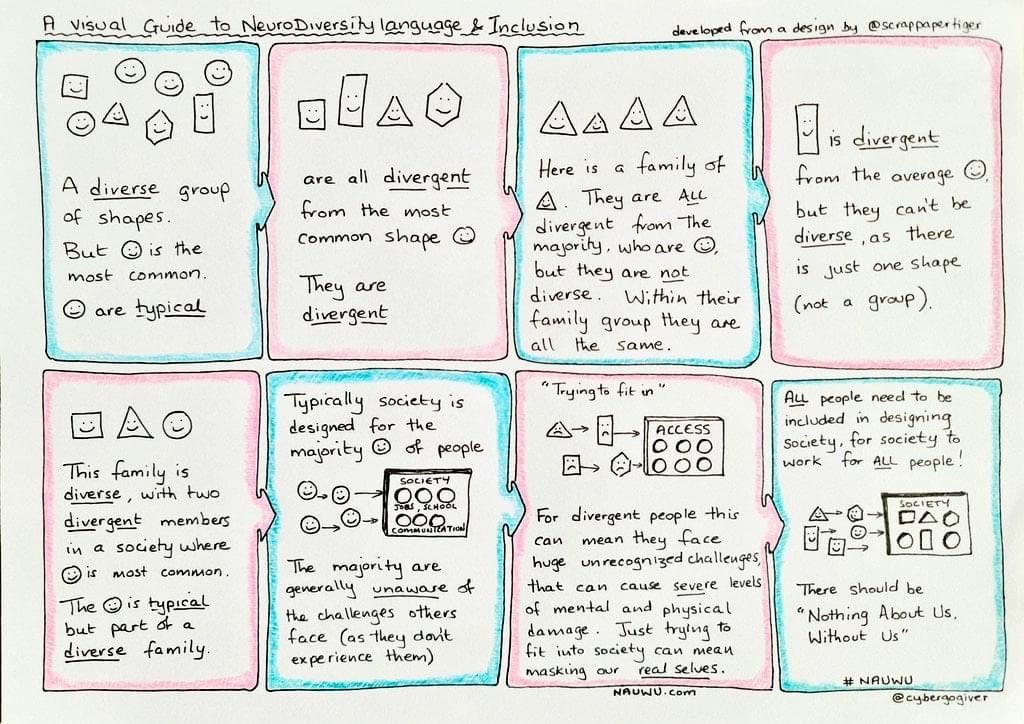
Neurodiversity is the bigger umbrella. The term was coined by autistic sociologist Judy Singer in the late 1990s, and it’s become a framework for understanding neurological differences as natural human variation. It’s the concept that neurological differences like autism, ADHD, dyslexia, dyspraxia, Tourette’s, and others are natural variations in how human brains work. Not deficits. Not disorders in the sense of something broken. Just different operating systems.

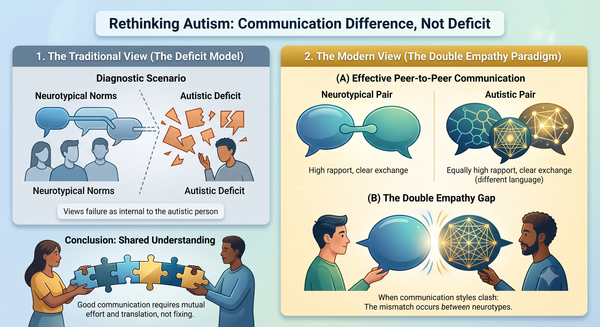
The neurodiversity paradigm recognizes that disability often comes from a mismatch between a person’s neurology and their environment, not from the neurology itself. A nonspeaking autistic person isn’t disabled by being nonspeaking. They’re disabled by a world that only values spoken communication and doesn’t provide AAC or presume competence. An ADHD person isn’t disabled by needing movement to think. They’re disabled by schools and workplaces that demand eight hours of sitting still.

This doesn’t mean neurodivergent people don’t face real challenges or that everything is just about acceptance. Many of us deal with genuine suffering, whether from sensory pain, communication barriers, executive dysfunction, or co-occurring conditions. The neurodiversity framework just says that the solution isn’t to make us “normal.” It’s to reduce suffering by building a world that works for different kinds of brains.

All of these terms are describing different ways brains can be wired and operate. They’re not value judgments. An autistic person isn’t “more” or “less” autistic based on their support level. A Level 3 autistic person isn’t less capable of having a rich internal life than a Level 1 autistic person. Someone who’s AuDHD isn’t confused or contradictory. And neurodivergent people aren’t failed versions of neurotypical people. We’re just running different neurological software, and that comes with its own strengths, challenges, and support needs.

When we talk about autism and neurodivergence through a neuro-affirmative lens, we’re acknowledging a few key things:

  • Difference isn’t deficit. Autistic brains process information differently, communicate differently, and experience the world differently. That’s not something to fix.
  • Support needs are valid at every level. Needing support doesn’t make you broken. Humans are interdependent. We all need support, just in different ways.
  • Autistic people are the experts on autism. Clinical definitions matter for access to services, but autistic voices matter more for understanding what it’s actually like to be autistic.
  • Communication happens in many forms. Speaking isn’t superior to typing, signing, using AAC, or communicating through behavior and body language.
  • Masking has costs. When autistic people hide their autism to fit in, it often leads to burnout, mental health struggles, and loss of self. Support should mean we can be ourselves, not that we have to perform neurotypicality.

The goal isn’t to fix or normalize anyone. It’s to understand how different brains work and create environments where all kinds of minds can actually thrive. That means flexibility in communication, sensory-friendly spaces, acceptance of stimming and other self-regulation strategies, and recognizing that there are many valid ways to be human.


Resources for Learning More (Neuro-Affirmative & Autism-Positive)

Autistic-Led Organizations:

  • Autistic Self Advocacy Network (ASAN) -

https://autisticadvocacy.org/


  • The leading autistic-run advocacy organization. Their resources section covers everything from policy to understanding autism from the inside.
  • Autistic Women & Nonbinary Network (AWN) -

https://awnnetwork.org/


  • Focused on autistic people who aren’t cis men, with resources about diagnosis, masking, and community.
  • Thinking Person’s Guide to Autism -

http://www.thinkingautismguide.com/


  • A collection of essays, resources, and perspectives from autistic people, parents, and allies committed to neurodiversity.

Books by Autistic Authors:

  • Unmasking Autism by Devon Price
  • Neurotribes by Steve Silberman (journalist, neuro-affirming historical account)
  • Loud Hands: Autistic People, Speaking edited by the Autistic Self Advocacy Network
  • We’re Not Broken by Eric Garcia
  • Drama Queen by Sara Gibbs (on AuDHD specifically)

Websites & Blogs:

  • Gliszening - https://gliszening.substack.com/ Neurodivergent perspectives on autism, social services, and neuro-affirmative approaches to understanding different minds.
  • NeuroClastic - https://neuroclastic.com/ Online magazine written by and for neurodivergent people.
  • Reframing Autism - https://reframingautism.org.au/ Australian organization with excellent resources on strengths-based approaches.
  • Neurodivergent Insights - https://neurodivergentinsights.com/ Run by autistic psychologist Dr. Megan Anna Neff, lots of info on AuDHD and late-identified autism.

For Understanding Nonspeaking/High Support Needs Autism:

  • I-ASC (International Association for Spelling as Communication) - https://i-asc.org/ Advocacy and education around AAC and presuming competence.
  • CommunicationFIRST - https://communicationfirst.org/ Disability rights organization advocating for people with speech-related disabilities.

Social Media Accounts to Follow: (Many autistic advocates share incredible education on platforms like Instagram, TikTok, and YouTube. Search for tags like #ActuallyAutistic, #AuDHD, and #NeurodivergentTok for current voices.)

These resources center autistic perspectives, presume competence, and approach autism as a neurological difference rather than a tragedy to be fixed. They’re good starting points for anyone wanting to understand autism and neurodivergence in ways that actually respect and affirm autistic people.