Using the Circle of Control During Life Transitions to Take Back Your Power

Share
Using the Circle of Control During Life Transitions to Take Back Your Power

If you’re reading this, you might be facing a big change - maybe starting college, looking for work, moving somewhere new, or figuring out relationships. Transitions can feel overwhelming, especially when the world wasn’t built with our needs in mind. But here’s what I’ve learned supporting autistic adults through these moments: you have more power than you think.

Are you on the precipice of a major life shift? This is the time to learn the tools to take control and grow through change.

Why Transitions Hit Us Differently

Let’s be real - change is hard for most people, but as autistic adults, we face some specific challenges. We lose our carefully built routines. We have to figure out new social landscapes without a map. Sensory environments shift without warning. And we’re doing all this while navigating systems that rarely consider how our brains work.

The research backs up what you already know from living it. Studies show that 40-50% of us meet criteria for anxiety disorders (Hollocks et al., 2019). But here’s the thing - this isn’t because we’re broken. It’s a completely rational response to living in a world that constantly asks us to perform neurotypicality while giving us few tools to work with our actual neurology.

Our brains are incredible at recognizing patterns and processing details. When transitions disrupt those patterns, it makes sense that we’d need extra energy to recalibrate. That’s not a deficit - that’s our brain doing exactly what it’s designed to do.

The Circle of Control: A Framework That Actually Helps

Stephen Covey’s Circle of Control model has been around since 1989, but I’ve found it particularly powerful for us. Here’s the basic idea: imagine three circles. The biggest one holds everything you worry about (your Circle of Concern). Inside that is what you can influence. And at the very center? What you actually control.

Neuroscience tells us something fascinating - when we focus on what we can control, our nervous system literally calms down. Perceived control is one of the strongest predictors of wellbeing and stress resilience (Skinner, 1996). For those of us whose nervous systems are already working overtime, this is game-changing.

When I worry about whether people will accept me as I am, whether I’ll find community, or if supports will be adequate - those are all in my Circle of Concern. Valid worries, absolutely. But pouring energy into them activates the same stress pathways as being chased by a predator. My brain can’t tell the difference between “What if they judge my stimming?” and “There’s a tiger behind me.”

But when I shift focus to what I can control? Something shifts. Research on self-efficacy shows that taking even small actions on controllable factors lights up our brain’s reward systems (Bandura, 1997). We go from feeling stuck to feeling capable.

Real Strategies for Real Transitions

Starting School or College

What you control: Getting accommodations set up before classes start (not waiting until you’re struggling). Visiting campus when it’s quiet to map out sensory-friendly spaces. Building your schedule with recovery time between classes. Choosing housing that works for your sensory needs - and yes, a single room is a valid accommodation need. Finding the disability resource center and autism support groups before you need them.

What you can influence: Your course load by starting part-time if needed. Professor understanding by being specific about your needs (”I process better with written instructions” works better than “I’m autistic”). Building connections through special interest clubs rather than forcing yourself into generic social mixers.

Work and Career

What you control: Researching companies that actually practice neurodiversity inclusion (not just talk about it). Preparing scripts for disclosure conversations if you choose to disclose. Requesting specific accommodations - noise-canceling headphones, written instructions, regular breaks. Choosing careers that align with your interests and strengths rather than fighting against your neurology. Setting boundaries around after-work socializing.

What you can influence: Workplace culture by connecting with employee resource groups. Your manager’s understanding by giving concrete examples of what helps you work best. Your professional network by seeking out other neurodivergent professionals.

Relationships and Connection

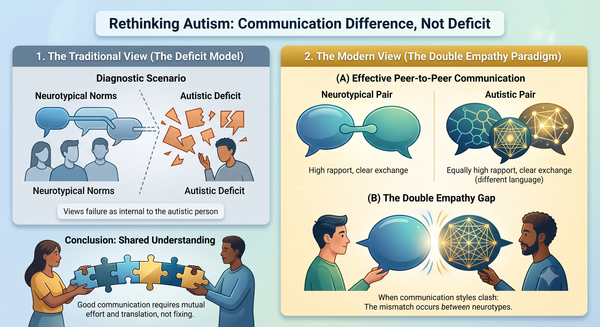
Here’s something revolutionary - recent research on the double empathy problem shows that communication difficulties happen because of neurotype mismatch, not because we’re socially impaired (Milton, 2012). We communicate fine with other autistic people. The “deficit” only appears in mixed neurotype interactions, and it goes both ways.

What you control: Seeking explicitly neurodivergent-friendly spaces. Being direct about your needs (”I prefer texting” is perfectly valid). Following up with specific invitations rather than waiting for vague “let’s hang out sometime” to materialize. Scheduling recovery time after social events. Sharing your actual interests instead of pretending to care about small talk.

What you can influence: The depth of friendships by showing up authentically. The pace of connection by being honest about your capacity. The quality of your relationships by finding your people - those who get excited about your interests and respect your boundaries.

Healthcare and Future Planning

What you control: Finding providers who actually understand autism (they exist, though they’re rare). Writing down your needs before appointments. Bringing a support person. Creating advance directives that reflect your actual wishes. Requesting accommodations like dimmed lights or written summaries.

What you can influence: Provider education by sharing resources. Your health outcomes by advocating firmly for yourself. System navigation by connecting with autistic-led advocacy organizations.

Making This Work in Real Life

Next time anxiety spikes about a transition, try this: pause and ask, “Is this in my circle of control?”

Worried about making friends at your new job? That worry makes sense, but it’s largely outside your control. What you can control: joining the company’s neurodiversity ERG, being upfront about preferring lunch alone to recharge, suggesting activity-based team bonding over unstructured happy hours.

This isn’t toxic positivity or pretending everything’s fine. It’s about recognizing where your energy actually makes a difference. Research on metacognition shows this simple awareness practice interrupts anxiety spirals and creates space for problem-solving (Flavell, 1979).

If You Have Supportive People in Your Life

Not everyone has family support, and that’s okay. But if you do have people who want to help, they can support your Circle of Control practice by helping break down overwhelming changes into specific steps, celebrating your wins (even tiny ones), and respecting your autonomy while offering scaffolding when needed.

The Truth About Empowerment

This isn’t about becoming neurotypical or “overcoming” autism. You’re not broken and you don’t need fixing. This is about recognizing that in a world that wasn’t built for us, we need strategies that work with our neurology, not against it.

Life transitions will always take extra energy for us. That’s not a personal failing - it’s a reality of living in a world designed for different brains. But when we focus on what we control, we transform from feeling helpless to building genuine capability. We create lives that honor who we actually are.

Start with one thing you can control today. Just one. Watch what grows from that centered, empowered place. You’ve got this, and you’re not alone.


References

Bandura, A. (1997). Self-efficacy: The exercise of control. W.H. Freeman.

Boulter, C., Freeston, M., South, M., & Rodgers, J. (2014). Intolerance of uncertainty as a framework for understanding anxiety in children and adolescents with autism spectrum disorders. Journal of Autism and Developmental Disorders, 44(6), 1391-1402.

Covey, S. R. (1989). The 7 habits of highly effective people. Free Press.

Flavell, J. H. (1979). Metacognition and cognitive monitoring: A new area of cognitive-developmental inquiry. American Psychologist, 34(10), 906-911.

Gelbar, N. W., Smith, I., & Reichow, B. (2014). Systematic review of articles describing experience and supports of individuals with autism enrolled in college and university programs. Journal of Autism and Developmental Disorders, 44(10), 2593-2601.

Hendricks, D. R., & Wehman, P. (2009). Transition from school to adulthood for youth with autism spectrum disorders. Focus on Autism and Other Developmental Disabilities, 24(2), 77-88.

Hollocks, M. J., Lerh, J. W., Magiati, I., Meiser-Stedman, R., & Brugha, T. S. (2019). Anxiety and depression in adults with autism spectrum disorder: A systematic review and meta-analysis. Psychological Medicine, 49(4), 559-572.

Mason, D., Ingham, B., Urbanowicz, A., Michael, C., Birtles, H., Woodbury-Smith, M., ... & Parr, J. (2019). A systematic review of what barriers and facilitators prevent and enable physical healthcare services access for autistic adults. Journal of Autism and Developmental Disorders, 49(8), 3387-3400.

Milton, D. E. (2012). On the ontological status of autism: The ‘double empathy problem’. Disability & Society, 27(6), 883-887.

Nolen-Hoeksema, S. (2000). The role of rumination in depressive disorders and mixed anxiety/depressive symptoms. Journal of Abnormal Psychology, 109(3), 504-511.

Rotter, J. B. (1966). Generalized expectancies for internal versus external control of reinforcement. Psychological Monographs: General and Applied, 80(1), 1-28.

Sapolsky, R. M. (2004). Why zebras don’t get ulcers (3rd ed.). Holt Paperbacks.

Scott, M., Falkmer, M., Girdler, S., & Falkmer, T. (2017). Viewpoints on factors for successful employment for adults with autism spectrum disorder. PLoS ONE, 12(5), e0178852.

Sedgewick, F., Hill, V., Yates, R., Pickering, L., & Pellicano, E. (2016). Gender differences in the social motivation and friendship experiences of autistic and non-autistic adolescents. Journal of Autism and Developmental Disorders, 46(4), 1297-1306.

Skinner, E. A. (1996). A guide to constructs of control. Journal of Personality and Social Psychology, 71(3), 549-570.


For more information about neurodiversity-affirming support through Gliszen Therapeutic, visitwww.gliszentherapeutic.com or contact Rachelle Goldenberg at hello@gliszen.me or 866-866-1904