When Autistic Traits Stop Being Convenient
Understanding Masking and Authenticity
People often say they support autistic people - until autistic people stop being convenient. Example, Greta.
Greta Thunberg has always been open about being autistic. She’s described it as a way her brain works - not a flaw to be fixed, but something that shapes how she sees the world. For a while, that honesty was celebrated. She was called inspiring. Brave. Refreshing.
As long as she stayed within people’s expectations.
The Double Standard
Greta speaks directly. She doesn’t soften her words to make them easier to swallow. She doesn’t wrap urgency in politeness. She doesn’t perform gratitude or niceness when the situation doesn’t call for it.
These are autistic traits - clarity, directness, moral consistency - and they are often praised in theory.
But when Greta shows them in practice, the response changes.
How We Judge Emotions: The Problem with “Reading” Faces
Here’s where neuroscience backs this up in an interesting way. Psychologist Lisa Feldman Barrett’s research challenges everything we thought we knew about reading emotions from faces. In her book “How Emotions Are Made,” she presents evidence that emotions aren’t universal signals written on faces that everyone can read the same way.
Instead, we construct meaning from facial expressions based on our cultural learning and past experiences. We’re not passive observers detecting emotions - we’re active participants building interpretations.
Barrett’s research team studied remote cultures like the Himba people in Namibia and found something striking: when people aren’t given a list of emotion words to choose from, they don’t categorize facial expressions the same way across cultures. The Himba grouped anger, disgust, and sadness together - expressions that Americans see as completely distinct.
“What does this mean for autistic people?”
It means the idea that there’s one “correct” way to show emotion or one “right” facial expression is culturally constructed, not a biological truth. When people criticize Greta for not smiling enough or say her expressions are “wrong,” they’re really saying she’s not performing emotions the way their culture taught them emotions should look.
Barrett’s research found that context matters enormously in how people interpret faces. The same facial configuration can be read as different emotions depending on the situation, the perceiver’s culture, and what the person viewing the face expects to see.
Think about how this plays out for autistic people. We’re told our facial expressions are “flat” or “inappropriate.” But what if the problem isn’t our faces - it’s that neurotypical people have been taught to expect certain performances, and when we don’t provide them, they fill in the gap with their own predictions? Often negative ones.
Barrett writes: “Emotions are not reactions to the world. You are not a passive receiver of sensory input but an active constructor of your emotions.” This applies to reading others’ emotions too. When people look at Greta and see “anger” or “aggression,” they’re constructing that interpretation based on what they expect emotional expression to look like.
Research shows that people from different cultures literally look at different parts of faces. Japanese participants focused heavily on eyes when interpreting emotions, while Americans scanned the whole face. If something this fundamental varies by culture, how can we claim there’s one universal “right” way to express feeling?
Back to Greta: Constructing Hostility From Authenticity
She’s called rude. Aggressive. Emotionally inappropriate. People criticize her tone instead of engaging with what she’s saying. They tell her to calm down. To smile more. To be less intense. To say things “better” - meaning quieter, softer, more comfortable.
When commentators attacked her, they didn’t just criticize her activism. They went after her autism directly. She was labeled “deeply disturbed” and described as having “mental disorders” by media personalities. This wasn’t about climate policy anymore - it was about punishing someone for being visibly autistic while refusing to hide it.
This is what can happen when autistic people unmask.
What Is Masking?
Masking - sometimes called camouflaging - happens when autistic people hide or minimize their autistic traits to fit neurotypical expectations. It’s a survival strategy learned from years of being told, directly or indirectly, that the way we naturally exist is wrong.
Research shows that masking is incredibly common in formal settings. In workplaces, autistic people mask to avoid discrimination, to get hired, to keep their jobs, to advance in their careers. Students mask at school to avoid social isolation and bullying.
Masking can look like:
- Forcing eye contact even when it’s uncomfortable or painful
- Suppressing stimming (repetitive movements that help with regulation)
- Scripting conversations and rehearsing “appropriate” responses
- Hiding sensory sensitivities and tolerating painful stimuli
- Performing enthusiasm or emotions you don’t feel
- Rewriting emails over and over to sound “friendlier”
- Avoiding talking about your interests to seem “normal”
One autistic person described it this way: “I treat my clothes rather like costumes, and certain items of clothing help me to uphold certain personality characteristics... They are all me at the core, but they are edited versions of me, designed to not stand out for the ‘wrong’ reasons.”
The Cost of Hiding
The moment autistic traits stop being inspirational and start being inconvenient, support often disappears.
What people don’t see is what masking costs. Studies have found that frequent masking across different contexts is associated with significantly higher stress levels. It’s linked to:
- Chronic exhaustion and burnout
- Anxiety and depression
- Lower self-esteem
- Feelings of self-betrayal and inauthenticity
- Social overload requiring extended recovery periods
- Increased risk of suicidal thoughts
One research participant said: “Masking is so much more WORK than the work we are paid to do.”
It’s not sustainable. Many autistic people who mask successfully in professional settings describe coming home completely depleted, unable to function, needing hours or days to recover. The relationships formed while masking often feel hollow because they’re based on a performance, not a real connection.
When Support Becomes Conditional
Greta’s experience shows us something important: acceptance of autism is often conditional.
When she first spoke out, her focus and dedication were celebrated. Her ability to absorb complex climate data and communicate it clearly was admired. Media highlighted how her autism gave her a unique perspective - calling it her “superpower.”

But that celebration lasted only as long as she remained polite. The moment she expressed anger - appropriate anger at a climate crisis being ignored - the narrative flipped. Suddenly, her autism wasn’t a superpower. It was weaponized against her.
This pattern repeats everywhere. Autistic traits are praised when they’re useful to others:
- Attention to detail (as long as you don’t point out actual problems)
- Honesty (as long as it’s not too honest)
- Passion (as long as it’s quiet)
- Focus (as long as it benefits the company)
But the same traits become problems when they challenge comfort:
- “Too blunt” when giving direct feedback
- “Difficult” when advocating for needs
- “Obsessive” when pursuing what matters
- “Intense” when showing genuine emotion
Other Examples
Greta isn’t alone in facing this double standard.
Temple Grandin, the renowned animal scientist and autism advocate, faced similar challenges. Her direct communication style and ability to think visually - traits directly connected to her autism - revolutionized livestock handling. But she’s also described decades of being told she was “too different,” of struggling in social situations where her honesty was seen as rudeness.
In workplaces everywhere, autistic employees describe the same pattern. One person shared: “The advantage of masking is that people do not take an instant dislike to you, so it is possible over time to build relationships.” Another said: “I don’t want to ruin social relationships [by unmasking].”
Think about what that means. People fear that showing their authentic self will destroy connections. They believe relationships can only exist if they hide who they really are.
The Right to Be Uncomfortable
Here’s what needs to change: we need to stop expecting autistic people to make everyone else comfortable all the time.
Barrett’s research shows us that the brain is constantly making predictions and constructing meaning. When neurotypical people encounter autistic communication, their brains predict based on what they’ve learned - and often predict incorrectly. A direct statement gets interpreted as rudeness. A neutral face gets read as anger or disinterest. Not making eye contact gets seen as dishonesty.
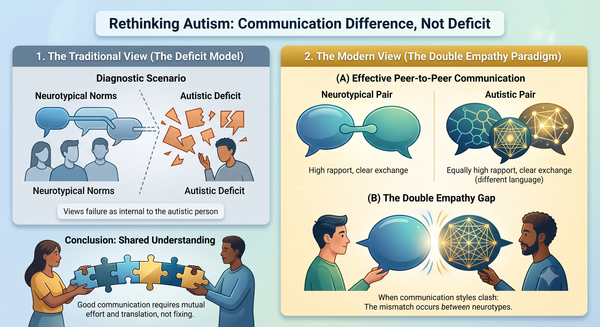
The problem isn’t the autistic person. The problem is that the observer’s brain is constructing meaning based on neurotypical norms, then treating that construction as objective reality.
Directness isn’t rude - it’s honest communication. Not smiling doesn’t mean someone is angry or hostile. Stimming isn’t “inappropriate” - it’s self-regulation. Avoiding eye contact isn’t disrespectful - it’s a different way of engaging.
When Greta says “How dare you?” at the UN Climate Summit, she’s not being emotional or inappropriate. She’s expressing a completely reasonable response to adults gambling with her generation’s future. The fact that people focus on her tone instead of her message tells us exactly what’s happening: her autism is only acceptable when it stays quiet and convenient.
Creating Space for Authenticity
Research on workplace masking found something interesting: having a formal autism diagnosis gave some people permission to unmask. They described feeling less obligated to hide. But they also noted how difficult it was after years of masking - “Sometimes, I cannot recognize that I’m masking in the first place.”
Creating genuinely supportive environments means:
At home and with friends:
- Accept stimming, avoiding eye contact, and other autistic traits
- Don’t expect constant emotional performance
- Respect need for alone time and sensory breaks
- Listen to what someone says, not how they say it
In schools:
- Provide quiet spaces and sensory accommodations
- Value different communication styles
- Don’t punish students for autistic traits
- Understand that masking drains energy needed for learning
In workplaces:
- Offer sensory accommodations (headphones, adjusted lighting, flexible seating)
- Value direct communication
- Don’t require unnecessary social performance
- Create psychological safety for people to be authentic
Everywhere:
- Stop telling autistic people to be “less intense” or “calm down”
- Engage with what someone is saying, not their tone
- Understand that different doesn’t mean wrong
- Recognize that your comfort isn’t more important than someone else’s authenticity
What Barrett’s Research Means for Autistic Acceptance
If emotions are constructed - not universal - then the whole framework of judging autistic people for “inappropriate affect” falls apart.
When we understand that emotional perception is learned and culturally variable, several things become clear:
Autistic people aren’t failing at universal emotional expression. There is no universal expression. The rules neurotypical people follow are cultural conventions, not biological imperatives.
The “flatness” neurotypical people perceive isn’t necessarily there. Research shows that when people expect to see certain emotional displays and don’t get them, their brains fill in the gap - often with negative interpretations. An autistic person experiencing joy might not show it the way a neurotypical observer predicts, so the observer’s brain constructs “no emotion” or even “negative emotion.”
Teaching autistic people to perform neurotypical emotional displays is teaching us to lie. If emotions are constructed from internal sensations and past experiences, forcing someone to display an emotion they’re not feeling is asking them to provide false information about their internal state.
Context matters more than we acknowledge. Barrett’s research emphasizes that the same facial configuration means different things in different contexts. But autistic people are often judged on our expressions in isolation, without consideration for context - and then told we’re wrong about what we’re feeling.
This reframes everything. The “deficit” isn’t in autistic emotional expression. The deficit is in neurotypical people’s ability to accurately interpret emotional expressions that don’t match their learned predictions.
The Real “Superpower”
Greta called her autism a superpower, and in a way, it is. The ability to see through social pretense, to focus intensely on what matters, to maintain moral consistency even when it’s uncomfortable - these aren’t flaws.
But the real test isn’t whether we celebrate these traits when they’re convenient. It’s whether we still accept them when they challenge us.
Autistic people shouldn’t have to earn acceptance by staying small, quiet, or palatable. Support that only exists when someone meets your comfort level isn’t support at all.
When Greta speaks with urgency about climate change, she’s not being “too emotional” - she’s being appropriately honest about an existential threat. When she doesn’t smile for cameras, she’s not being difficult - she’s just not performing emotions she doesn’t feel.
This is what unmasking looks like. And if that makes you uncomfortable, maybe that discomfort is worth sitting with.
Because autistic people have been uncomfortable their whole lives, forcing themselves into shapes that don’t fit, just so others can feel at ease. Maybe it’s time for that to shift.
Resources for Further Learning
Books:
- “How Emotions Are Made: The Secret Life of the Brain” by Lisa Feldman Barrett
- “Unmasking Autism: Discovering the New Faces of Neurodiversity” by Devon Price
- “Neurotribes: The Legacy of Autism and the Future of Neurodiversity” by Steve Silberman
Research:
- Barrett, L.F., Adolphs, R., Marsella, S., Martinez, A.M., & Pollak, S.D. (2019). “Emotional Expressions Reconsidered: Challenges to Inferring Emotion From Human Facial Movements”
- Gendron, M., Roberson, D., van der Vyver, J.M., & Barrett, L.F. (2014). “Perceptions of Emotion from Facial Expressions Are Not Culturally Universal”
- Cage, E., & Troxell-Whitman, Z. (2019). “Understanding the Reasons, Contexts and Costs of Camouflaging for Autistic Adults”
- Pearson, A., & Rose, K. (2021). “A Conceptual Analysis of Autistic Masking”
- Hull, L. et al. (2020). “Development and Validation of the Camouflaging Autistic Traits Questionnaire”
Author’s Note: This article centers autistic voices and experiences, including direct quotes from autistic individuals about their experiences with masking. The language used is neuro-affirmative, recognizing autism as a natural variation in human neurology rather than a disorder to be fixed. The integration of Lisa Feldman Barrett’s research on constructed emotion provides neuroscientific support for understanding that differences in emotional expression are not deficits - they’re variations in a system that’s far more culturally learned than most people realize.