When Worry Works: Understanding Your Brain's Planning System

Share
When Worry Works: Understanding Your Brain's Planning System

If you’ve been told your worry is irrational, excessive, or something you need to “just stop doing,” I want to offer you a different way of thinking about what’s happening in your brain.

Worry isn’t a malfunction. It’s not evidence that something is wrong with you. Your brain is doing exactly what it evolved to do: scan for threats, run simulations, and try to keep you safe. The problem isn’t that you worry. The problem is when worry gets stuck - when it loops without leading anywhere, when it exhausts you instead of preparing you, when it feels more like drowning than planning.

For neurodivergent folks especially, this can feel even more intense. ADHD brains might jump from worry to worry, unable to hold focus long enough to resolve any single concern. Autistic brains might get caught in recursive loops, analyzing the same scenario from every possible angle without finding an exit point. And for many of us, the meta-worry kicks in too: “Why can’t I stop worrying? What’s wrong with me that I can’t let this go?”

That meta-layer? That’s often where the real pain lives.

What Worry Actually Does

From a neuroscience perspective, worry activates a network of brain regions that includes your prefrontal cortex (planning and problem-solving), your amygdala (threat detection), and your anterior cingulate cortex (conflict monitoring). When this system works well, it helps you:

  • Identify potential problems before they happen
  • Generate possible solutions
  • Prepare emotionally and practically for challenges
  • Make decisions about what matters enough to act on

This is adaptive worry. It moves. It has a direction. It leads somewhere.

But here’s what happens when worry becomes maladaptive: the same neural circuits fire, but they don’t complete the cycle. You identify the problem, but you can’t land on a solution - or you generate a solution but immediately see ten new problems. The loop keeps running, burning energy without producing relief. Your nervous system stays activated, your body stays tense, and you’re left feeling exhausted but no more prepared than when you started.

Why Neurodivergent Brains Might Experience This Differently

A lot of neurodivergent people I’ve worked with describe worry that feels qualitatively different from what neurotypical descriptions capture. It’s not always about catastrophizing or overestimating danger. Sometimes it’s about:

  • Pattern recognition that’s so sensitive you see connections and potential outcomes others miss (which means more variables to worry about)
  • Executive function challenges that make it hard to prioritize which worries need attention and which can wait
  • Sensory or cognitive processing that makes uncertainty feel physically uncomfortable, not just mentally distressing
  • Past experiences where you actually did miss something important, got blindsided, or faced consequences others didn’t see coming - so your brain learned to scan even more carefully

Your worry might also be doing double duty. Research suggests that sometimes worry serves as a way to avoid feeling something else that’s harder to face. If you’re worried about whether you said the wrong thing in a conversation, you might not have to feel the deeper fear that people don’t actually like you. If you’re worried about logistics and schedules, you might not have to sit with grief or disappointment about something that can’t be fixed with planning.

This isn’t weakness. It’s your nervous system trying to protect you in the only way it knows how.

The Circle of Control: Where to Put Your Energy

One of the most practical tools for working with worry comes from Stephen Covey’s concept of the circle of control, and it’s especially helpful for neurodivergent brains that can get overwhelmed by the sheer volume of things to think about.

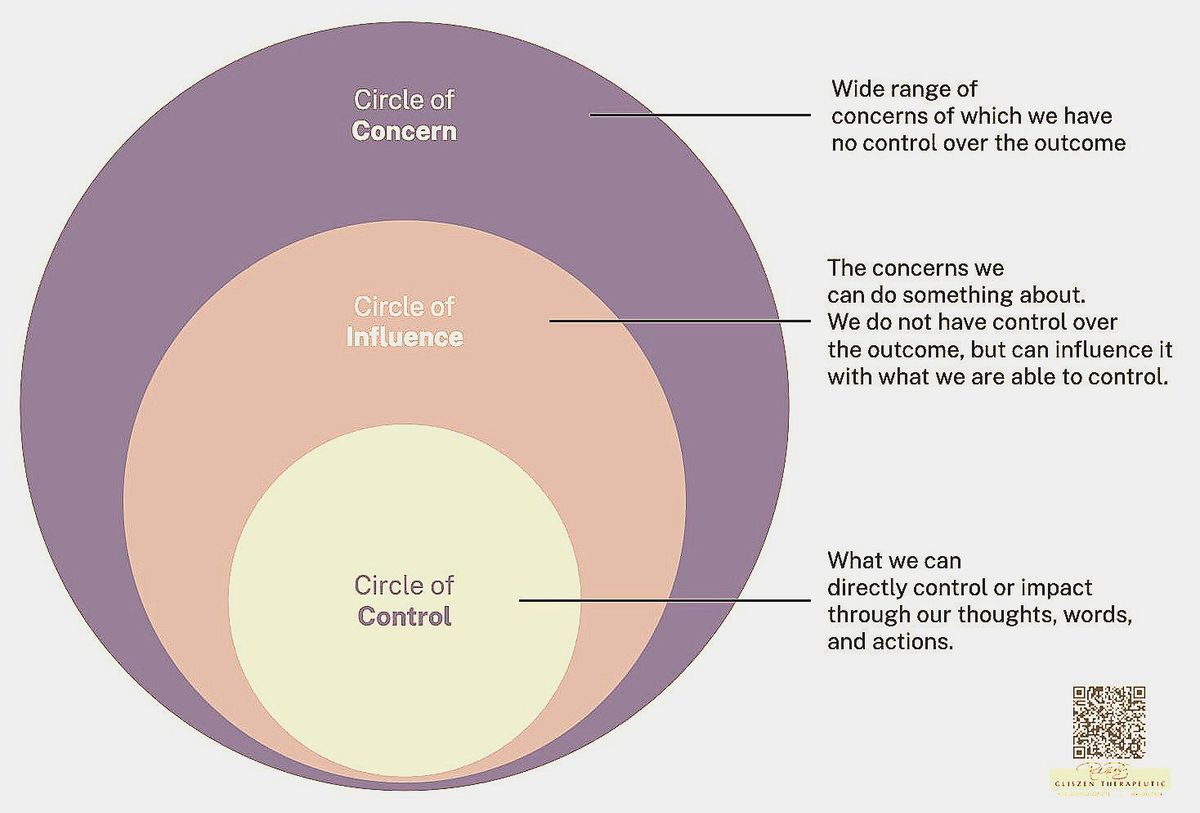
Picture three concentric circles:

The innermost circle is your Circle of Control - things you can directly influence. Your actions, your responses, how you spend your time today, what you say in a conversation.

The middle circle is your Circle of Influence - things you can’t control directly but where you have some impact. How others perceive you (you can’t control it, but your behavior influences it), some aspects of your health, certain relationship dynamics.

The outer circle is your Circle of Concern - things that affect you but that you have no control or influence over. The economy, other people’s opinions, past events, what might happen in five years, whether someone else will change.

Here’s what happens with stuck worry: it camps out in that outer circle. You spend energy on things you fundamentally cannot change, which means your nervous system stays activated but you never get the relief of effective action. Your brain is spinning its wheels.

When you can identify which circle a worry belongs in, something shifts. If it’s in your circle of control, you can ask: “What’s one thing I can do about this?” If it’s in your circle of influence, you might ask: “What can I do that might help, while accepting I can’t determine the outcome?” And if it’s in your circle of concern - outside both control and influence - the work becomes about acceptance and letting your nervous system know that scanning for solutions here isn’t productive.

For ADHD folks who might have fifteen worries active at once, this framework helps with triage. You can literally sort your worries: “Which of these can I actually do something about right now?” For autistic folks who might need clear categories and logic, it provides structure for what otherwise feels like an overwhelming cloud of concerns.

The circle of control doesn’t make worry disappear. But it helps worry do what it’s supposed to do: point you toward meaningful action instead of endless analysis.

woman in white knit sweater and blue denim jeans sitting on gray sofa chair reading book
Photo by Alexandra Fuller on Unsplash

Moving from Spiral to Function

So how do we help worry do its job without it taking over your life? Here are some approaches that come from both neuroscience research and what actually helps people:

Externalize it. Get the worry out of your head and onto paper, into a voice memo, or into a conversation. When worry stays internal, it can loop infinitely. Once it’s external, your brain can actually work with it. You can see it, organize it, reality-test it. For many neurodivergent folks, this is non-negotiable - trying to “process” worry entirely in your head is like trying to organize a messy room in the dark.

Distinguish between problem-solving worry and rumination worry. Problem-solving worry asks: “What can I do about this?” Rumination worry asks: “What if?” over and over without moving toward action. When you notice you’re ruminating, you can gently redirect: “Okay, I’ve thought about this scenario. What’s one small thing I could do right now, or is this something I need to accept uncertainty about?”

For ADHD brains that bounce between worries, it can help to literally make a list. “Here are my current worries.” Then ask of each one: “Is there an action I can take? Do I need more information? Or is this something I have to tolerate not knowing right now?” You’re essentially sorting them into those circles of control, influence, and concern.

Set boundaries with your worry time. This sounds counterintuitive, but research on “worry postponement” shows it can actually help. Instead of trying to shut worry down (which often backfires), you say: “I hear you. I’m going to think about this at 7pm.” Then at 7pm, you actually spend 15-20 minutes engaging with those worries. Often by then, some have resolved themselves. The ones that remain, you give focused attention.

Check your nervous system state. Sometimes what feels like cognitive worry is actually your body in a state of activation first, and your brain is searching for a reason second. If your heart is racing, your breathing is shallow, or you feel jittery, worry might be your brain’s attempt to explain sensory or physiological distress that’s already happening. In those moments, regulating your body (movement, breathing, cold water, pressure) might be more effective than trying to think your way out.

persons hand with water
Photo by Ruthson Zimmerman on Unsplash

Question the urgency. Worry often comes with a sense that you need to figure this out RIGHT NOW. But do you? Is there actually a decision that needs to be made in this moment, or is your brain treating uncertainty as emergency? Neurodivergent brains can be especially prone to this - when everything feels equally urgent, nothing gets the focused attention it actually needs.

The Reframe That Matters

Here’s what I want you to take from this: you’re not broken because you worry. Your brain is working hard to protect you. The goal isn’t to eliminate worry - it’s to help it move from spiral into function, from stuck into purposeful.

That might mean learning to distinguish between worries you can act on and worries you need to accept. It might mean building more capacity to tolerate uncertainty without your nervous system treating it as threat. It might mean finding the rhythm that works for your particular brain - the ADHD person who needs worry broken into immediate next-steps, the autistic person who needs to map out the full scenario before they can let it go.

There’s no one right way to work with worry. But there is your way - the approach that respects how your brain actually operates instead of trying to force it into a neurotypical template.

And if you’re a therapist reading this: our neurodivergent clients aren’t being difficult when standard anxiety interventions don’t land. They might need adaptations that account for executive function, sensory processing, or the reality that their pattern recognition really does pick up on things others miss. Meeting worry with curiosity instead of pathology opens up so much more possibility.

Worry wants to help you. Sometimes it just needs a little support to remember how.


Further Reading

black and green plastic containers
Photo by Delano Ramdas on Unsplash

If you want to dig deeper into these ideas, here are some resources that offer practical, neuroaffirmative approaches:

  • The Worry Trick by David Carbonell - breaks down how worry works and offers concrete strategies for working with it rather than against it
  • Unwinding Anxiety by Judson Brewer - explores the neuroscience of anxiety habits and how to interrupt the loops
  • The 7 Habits of Highly Effective People by Stephen Covey - where the circle of control framework originated (habit 1 focuses on this concept)
  • Divergent Mind by Jenara Nerenberg - for understanding how neurodivergent brains process worry, anxiety, and uncertainty differently
  • Burnout by Emily and Amelia Nagoski - particularly helpful for understanding the connection between body states and worry cycles